
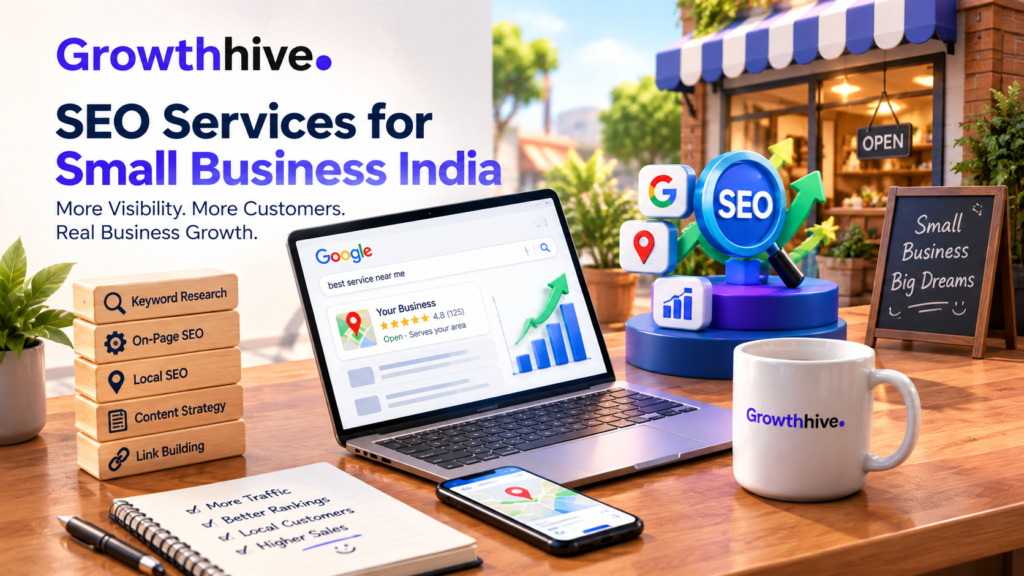
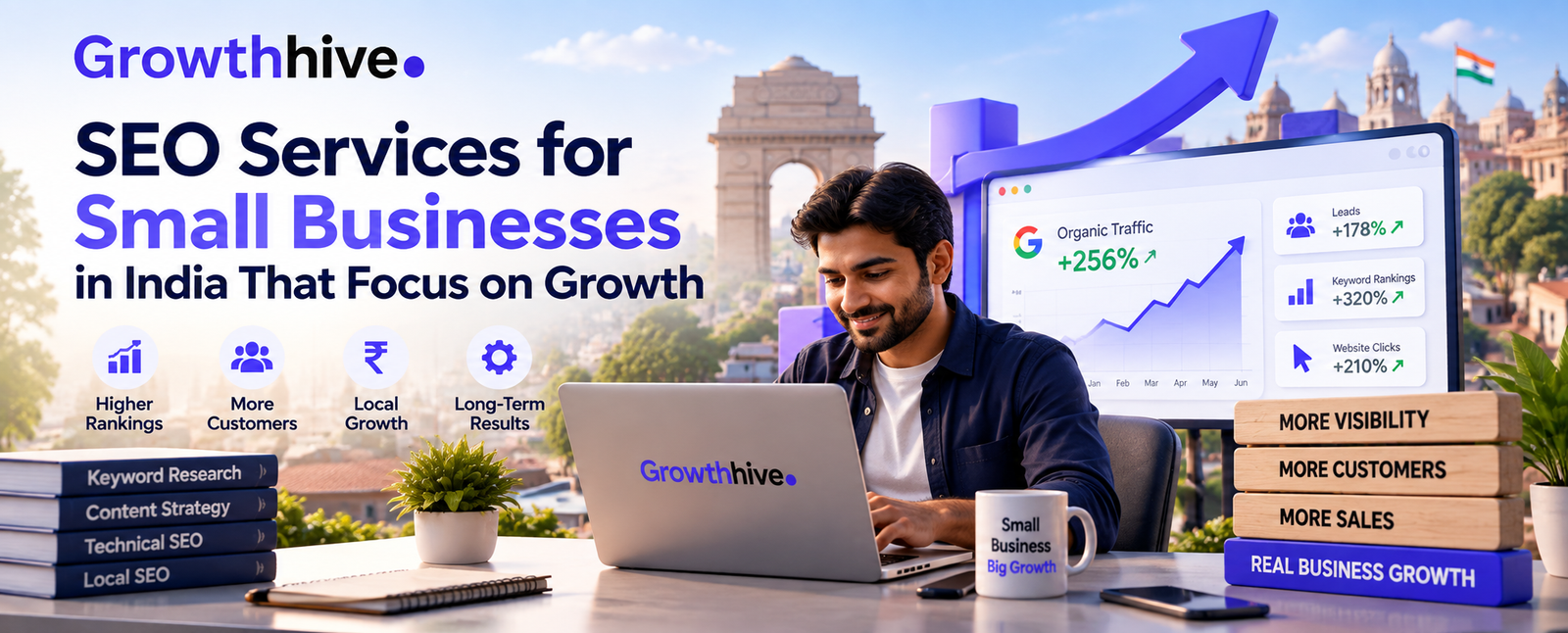
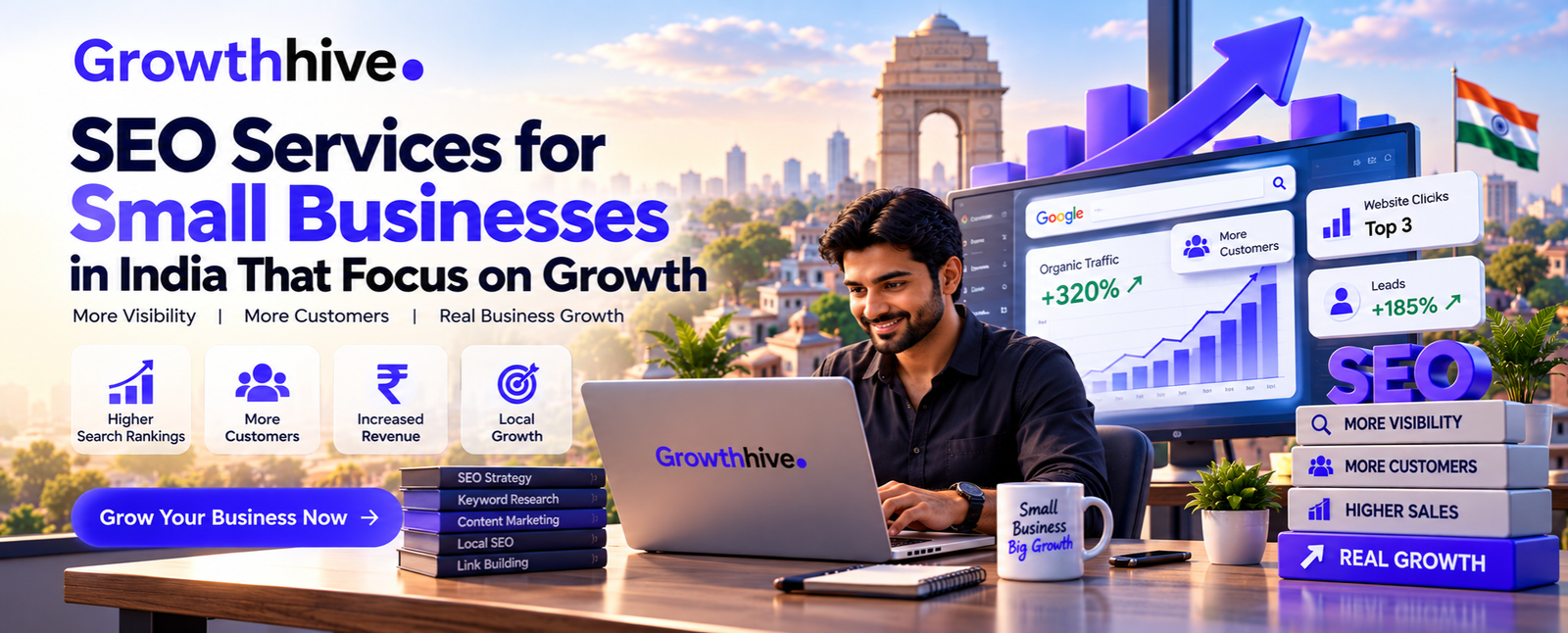
SEO Services for Small Businesses in India That Focus on Growth
If your small business website is not generating enough organic traffic, inquiries, or customers, the problem may not simply be that you need “more SEO.
You need the right SEO strategy for your business, market, customers, and commercial goals.
GrowthHives provides SEO services for small businesses in India designed around the areas that can influence organic growth: technical website health, search intent, on-page optimization, content, local visibility, authority, conversion opportunities, and ongoing measurement.
The objective is not to generate traffic that does nothing for your business.
The objective is to attract people who are actively looking for the products or services you provide and create a stronger path from Google search → website → trust → inquiry → customer.
Whether you operate a local service business, professional practice, ecommerce store, B2B company, startup, or another small business, the SEO strategy should reflect how your customers actually search and make purchasing decisions.
What Are SEO Services for Small Businesses?
SEO services for small businesses are a set of strategies and ongoing activities designed to improve a company’s visibility in organic search results and help attract relevant potential customers.
For a small business, SEO can include:
- Technical SEO
- Keyword and search-intent research
- On-page SEO
- Content strategy
- Local SEO
- Internal linking
- Website architecture improvements
- Conversion-focused optimization
- Authority and link-building activities
- Google Business Profile optimization where applicable
- Search performance measurement
- AEO and emerging AI-search considerations
- Ongoing SEO strategy and prioritization
However, not every small business needs the same combination of activities.
A local plumber, an ecommerce brand, a software company, and a B2B manufacturer may all need SEO, but their search journeys are different.
Effective small-business SEO starts with understanding the business before deciding what to optimize.
Why Small Businesses Need a Different SEO Approach
Large companies may have extensive websites, established brands, large content teams, and significant marketing resources.
Small businesses often have different constraints.
You may have:
- A limited marketing budget
- A small website
- A small marketing team
- Limited content resources
- A highly specific target market
- Strong local competition
- Limited brand recognition
- A small number of commercially important services
- A need to generate leads rather than simply increase traffic
That means SEO should be prioritized according to business impact.
Instead of publishing dozens of pages simply because keywords exist, a small business can benefit from identifying the pages, searches, topics, and audiences most closely connected to revenue.
A practical small-business SEO priority model
Business Goal → Customer Search → Commercial Page → Supporting Content → Authority → Conversion → Measurement
This approach helps prevent SEO from becoming a collection of disconnected tasks.
What SEO Services Does a Small Business Actually Need?
There is no universal SEO package that is right for every small business.
The appropriate scope depends on the website, industry, competition, target location, existing authority, search demand, and business objectives.
A practical SEO program may include the following.
1. SEO Audit and Strategy
The first step is understanding the current situation.
An SEO audit can examine:
- Indexability
- Crawlability
- Website structure
- Page titles and descriptions
- Heading structure
- Internal links
- Canonicalization
- XML sitemap
- Robots.txt
- Duplicate or thin pages
- Mobile experience
- Core Web Vitals and page experience considerations
- Content quality
- Search intent alignment
- Existing rankings
- Organic traffic
- Conversion paths
- Local search signals where relevant
The audit should not become a checklist of technical issues with no business context.
The important question is:
Which problems should be fixed first because they can materially affect organic performance or the customer journey?
2. Keyword Research Based on Business Intent
Keyword research for a small business should go beyond finding phrases with high search volume.
The more useful question is:
Which searches are most likely to represent a potential customer?
For example, a hypothetical local business could encounter searches at different stages:
| Search Type | Example | Intent |
|---|---|---|
| Informational | how to repair a leaking tap | Information |
| Problem-solving | plumber for leaking tap | Commercial |
| Service | emergency plumber near me | Transactional |
| Brand | ABC Plumbing | Navigational |
| Evaluation | plumber cost in Delhi | Commercial investigation |
A small business may not need to pursue every possible keyword.
It may be more valuable to build visibility around searches that connect directly to its products, services, locations, and customer problems.
3. On-Page SEO
On-page SEO ensures that important pages clearly communicate what they offer and whom they serve.
This can include optimizing:
- Page titles
- Meta descriptions
- H1 and heading structure
- Service descriptions
- Search intent alignment
- Content structure
- Image alt text
- Internal links
- URLs
- Entity and topic relationships
- Calls to action
- Supporting FAQs
The objective is not to repeat a keyword as many times as possible.
Instead, the page should make its subject, purpose, audience, and value clear to both users and search systems.
4. Technical SEO
Technical SEO helps ensure that search engines can access, crawl, understand, and index important website content.
Depending on the website, technical SEO may address:
- Crawlability
- Indexing
- XML sitemaps
- Robots.txt
- Canonical URLs
- Redirects
- HTTP status codes
- Duplicate content
- JavaScript-related issues
- Site architecture
- Internal linking
- Structured data
- Mobile usability
- Performance considerations
Not every technical issue requires immediate action.
A strong small-business SEO strategy prioritizes technical changes based on their actual relevance to the website and search journey.
Google provides official documentation covering Search Essentials and SEO guidance for websites.
5. Content Strategy
Content should support the commercial pages that matter to the business.
Instead of publishing random blog posts, GrowthHives can structure content around customer questions, problems, comparisons, and decision-making journeys.
For example, a service business could build a content cluster around:
Core Service Page
↓
Supporting Problem-Solving Content
↓
How-To Content
↓
Comparison Content
↓
FAQ Content
↓
Relevant Internal Links
↓
Commercial Service Page
This creates a stronger relationship between informational content and revenue-focused pages.
Good small-business content answers real customer questions
Examples include:
- What does this service involve?
- How much does it generally depend on?
- What problems does it solve?
- When should I hire a professional?
- What should I look for when choosing a provider?
- What mistakes should I avoid?
- What is the difference between two solutions?
- What should I expect from the process?
The exact topics should be determined by the business and its customers rather than generated solely to increase page count.
6. Local SEO for Small Businesses
For businesses that serve customers in specific geographic areas, local SEO can be an important part of the strategy.
This may involve:
- Google Business Profile optimization
- Accurate business information
- Local landing pages where genuinely useful
- Location-relevant content
- Reviews and review management
- Local citations where appropriate
- Internal linking
- Local business structured data
- Location-specific conversion elements
Google states that local results are primarily influenced by relevance, distance, and prominence, and recommends keeping Business Profile information complete and accurate.
A small business should also avoid creating large numbers of near-identical location pages simply to target city names.
A useful location page should provide genuine local value.
7. Google Business Profile Optimization
For eligible local businesses, the Google Business Profile can be an important part of the local search ecosystem.
Accurate business details can help customers understand:
- What the business does
- Where it operates
- When it is available
- How to contact it
- What it looks like
- What customers say about it
Google also recommends maintaining accurate business information and responding to customer reviews.
The website and Business Profile should support the same underlying business information.
8. Internal Linking
Internal links are often overlooked by small businesses.
A strategic internal-linking system can help users move between related pages while creating clearer relationships between important topics.
For example:
SEO Services
→ Local SEO
→ Technical SEO
→ SEO Content Strategy
→ SEO for Small Businesses
→ SEO Strategy
The links should be useful to the reader rather than inserted simply to increase the number of links.
For this page, the primary GrowthHives service connection is the broader SEO services offering:
SEO services can serve as the next step for businesses that need a broader SEO strategy beyond a single optimization task.
9. Authority Building
A new or less-established business website may need to build stronger authority and recognition within its market.
Depending on the business, this can involve:
- Relevant digital PR
- Industry references
- Genuine partnerships
- Useful resources
- Editorial mentions
- Relevant link acquisition
- Brand citations
- High-quality content that earns references
The goal should be relevance and credibility—not collecting large numbers of unrelated backlinks.
A backlink is more useful when it makes sense in the context of the website, industry, audience, and referenced resource.
10. Conversion-Focused SEO
Ranking is only part of the business outcome.
A visitor who reaches a website but cannot understand what to do next may never become a lead.
SEO should therefore consider the conversion journey.
Important elements may include:
- Clear service information
- Strong value proposition
- Easy contact options
- Relevant calls to action
- Trust information
- FAQs
- Service-area information
- Clear pricing guidance where appropriate
- Contact forms
- Phone or WhatsApp options where relevant
- Evidence that helps users evaluate the business
The exact conversion elements depend on the business model.
A high-intent service page should make the next step obvious without forcing the visitor into an aggressive sales funnel.
SEO for Different Types of Small Businesses
The strategy should change according to the business model.
Local Service Businesses
Examples include:
- Plumbers
- Dentists
- Clinics
- Salons
- Repair companies
- Legal services
- Home services
- Cleaning businesses
- Travel businesses
These businesses may benefit from a combination of local SEO, service pages, location relevance, reviews, and conversion optimization.
Ecommerce Small Businesses
Ecommerce SEO may require greater focus on:
- Category pages
- Product pages
- Product architecture
- Search intent
- Product descriptions
- Internal linking
- Faceted navigation
- Technical SEO
- Product structured data
- Informational content
- Commercial category content
The strategy should help customers discover products and move toward purchase.
B2B Small Businesses
B2B SEO often involves longer research journeys.
Potential content can include:
- Service pages
- Industry pages
- Solution pages
- Comparison content
- Implementation guides
- Technical resources
- FAQs
- Case studies when real and verifiable
- Buyer-focused educational content
The objective is to build visibility throughout the research process rather than targeting only one transactional query.
Startups
Startups may need to balance:
- Brand development
- Organic acquisition
- Technical foundations
- Product/service positioning
- Content strategy
- Commercial pages
- Limited resources
SEO priorities should therefore be tied closely to the startup’s acquisition model and target audience.
A Practical Small-Business SEO Process
Growth Hives can structure SEO around a continuous process rather than isolated monthly tasks.
Step 1: Understand the Business
Start with: Products Services Customers Locations Business model Revenue priorities Competitive environment Existing marketing channels
Step 2: Audit the Website
Identify technical, content, structural, and conversion issues.
Step 3: Map Search Intent
Connect search behavior with: Services Products Customer problems Locations Buying stages
Step 4: Prioritize Pages
Not every URL deserves equal attention. Focus first on pages with meaningful commercial potential.
Step 5: Build Supporting Content
Create content that strengthens the main commercial topics.
Step 6: Improve Internal Authority
Connect relevant pages through contextual internal links.
Step 7: Strengthen External Authority
Pursue relevant, credible references and mentions.
Step 8: Improve Conversion Paths
Make it easier for qualified visitors to become inquiries.
Step 9: Measure Business-Relevant Outcomes
Monitor organic performance alongside meaningful business indicators.
Step 10: Refine the Strategy
SEO should be iterative. Search behavior, competition, website performance, content performance, and business priorities can change over time.
How Long Does SEO Take for a Small Business?
There is no universal SEO timeline that applies to every business.
The time required can depend on factors such as:
- Website history
- Technical condition
- Existing authority
- Competition
- Target locations
- Industry
- Content quality
- Search intent
- Website size
- Resources available
- Scope of implementation
A business should therefore be cautious about anyone promising a fixed ranking or guaranteed outcome within a specific number of days.
A better approach is to establish measurable milestones and evaluate progress continuously.
Possible measurements include:
- Organic impressions
- Organic clicks
- Search visibility
- Ranking changes for relevant queries
- Growth of commercially relevant landing pages
- Organic leads
- Contact actions
- Qualified inquiries
- Conversion rate
- Revenue attributable to organic acquisition where measurable
How Much SEO Does a Small Business Need?
The answer depends on the business.
A small local company with five important services may need a very different SEO program from an ecommerce store with thousands of products.
A useful framework is:
| Business Situation | Potential SEO Priority |
|---|---|
| New local business | Technical foundation + local SEO + service pages |
| Established local business | Local SEO + commercial pages + authority |
| Small ecommerce store | Category/product SEO + technical SEO + content |
| B2B company | Commercial pages + topical content + authority |
| Startup | Strategy + technical foundation + high-value content |
| Weak existing website | Audit + architecture + on-page + technical fixes |
| Strong website with low traffic | Search-intent research + content + authority |
| High traffic but low leads | Conversion optimization + commercial intent |
The important point is that SEO scope should follow business needs rather than a generic checklist.
What Should You Look for in an SEO Agency?
Choosing an SEO provider is an important decision because SEO requires ongoing strategic and implementation work.
Before hiring an agency, ask:
1. Do they understand your business?
An agency should be able to explain how your customers search and how SEO connects with your commercial model.
2. Can they explain their strategy?
You should understand what they plan to improve and why.
3. Do they focus only on rankings?
Rankings matter, but they are not the entire business outcome.
Ask how they connect SEO with relevant traffic, conversions, inquiries, and business goals.
4. How do they measure progress?
Ask what metrics they will report and how frequently.
5. Do they explain risks and limitations?
SEO involves uncertainty. A transparent provider should not present search rankings as something that can simply be guaranteed.
6. Will they prioritize your most valuable pages?
More content is not automatically better.
The strategy should identify which pages and topics deserve investment.
Common SEO Mistakes Small Businesses Should Avoid
Publishing Content Without a Strategy
A large blog does not automatically create organic growth.
Every major piece of content should have a clear purpose.
Targeting Only High-Volume Keywords
High search volume does not necessarily mean high commercial value.
A smaller keyword with strong purchase intent may be more relevant to a small business.
Creating Duplicate Location Pages
Replacing one city name with another does not automatically create useful local content.
Location pages should provide genuine local value.
Ignoring Technical SEO
A strong content strategy can struggle if important pages cannot be properly crawled, indexed, or understood.
Focusing Only on Rankings
A ranking without relevant traffic or conversions may have limited business value.
Buying Irrelevant Backlinks
SEO authority should be built around relevance and credibility rather than simply accumulating links.
Neglecting Conversion Optimization
Organic visitors still need a clear reason and path to contact or purchase.
Expecting Instant Results
SEO is generally an ongoing process rather than an instant marketing channel.
How GrowthHives Approaches Small Business SEO
GrowthHives approaches SEO as an organic growth system, not simply a ranking activity.
The strategy can bring together:
Technical SEO
A technically sound foundation helps search engines access and understand important website content.
On-Page SEO
Important pages are aligned with their intended search queries and customer needs.
Content Strategy
Supporting content is developed around genuine customer questions and commercially relevant topics.
Local SEO
Where location matters, the strategy incorporates local search signals and location-specific relevance.
Authority Building
Relevant external references and brand visibility can support the broader SEO strategy.
Conversion Optimization
Traffic should have a logical path toward an inquiry, booking, purchase, or other meaningful business action.
Measurement
Performance is evaluated using meaningful search and business metrics rather than one ranking position alone.
SEO and AI Search Visibility
Search is increasingly incorporating AI-generated experiences, making it useful for businesses to think beyond traditional blue-link rankings.
For AI-oriented search visibility, content should be:
- Clear
- Factual
- Well structured
- Contextually relevant
- Easy to understand
- Explicit about important relationships
- Useful for real questions
- Supported by trustworthy information
SEO, AEO, GEO, AI search visibility, and LLM citations are related concepts, but they should not be treated as identical.
There is also no legitimate way to guarantee that a specific business will appear in every AI-generated answer or receive a citation from a particular AI system.
The stronger approach is to build content that genuinely deserves to be understood, referenced, and discovered.
Structured Data and Search Understanding
Structured data can help search engines understand specific information about a page.
For example, Google documents LocalBusiness structured data for businesses and explains how relevant business information can be provided in a standardized format.
Structured data should be implemented where it genuinely represents the page.
It should not be added simply because a schema type sounds useful.
Google also notes that structured data does not guarantee that a particular search feature will appear.
A Small-Business SEO Checklist
Before investing in an SEO campaign, check whether your strategy addresses:
Clear business objectives
Defined target customers
Relevant search intent
Technical SEO foundation
Important commercial pages
Keyword-to-page mapping
Useful content strategy
Internal linking
Local SEO where applicable
Google Business Profile where eligible
Conversion optimization
Relevant authority building
Search performance tracking
Lead measurement
Ongoing strategy refinement
This creates a more useful foundation than simply asking an agency to “get more keywords ranking.
Build an SEO Strategy Around Your Business
Small-business SEO should not begin with a list of random keywords.
It should begin with a business question:
Who do you want to reach, what are they searching for, and which search journeys can realistically contribute to business growth?
From there, the strategy can connect technical SEO, content, on-page optimization, local visibility, authority, conversion opportunities, and measurement.
If your business already has a website but organic visibility and qualified inquiries are not where you want them to be, the next step is to identify what is limiting growth rather than simply publishing more content.
Need a clearer SEO strategy for your small business?
Explore GrowthHives’ SEO services to discuss your website, search opportunities, and organic growth requirements.
The goal is simple:
Better search visibility → More relevant visitors → More qualified opportunities → Sustainable organic growth.
Frequently Asked Questions
Is SEO suitable for small businesses in India? + -
Yes, SEO can be suitable for many small businesses, particularly those whose customers use search engines to research products, services, businesses, or solutions. The appropriate strategy depends on the business model, market, competition, website, and customer journey.
What SEO services does a small business need? + -
A small business may need technical SEO, keyword research, on-page optimization, content strategy, local SEO, internal linking, authority building, conversion optimization, and ongoing measurement. The exact scope should be determined by business priorities rather than a fixed checklist.
Is local SEO important for small businesses? + -
For businesses that serve customers in specific geographic areas, local SEO can be highly relevant. Google says local search results are mainly based on relevance, distance, and prominence.
How much does small-business SEO cost? + -
There is no single appropriate SEO price for every small business. Cost can vary according to competition, target market, website condition, number of pages, technical complexity, content requirements, authority-building needs, industry, and scope of work.
A useful evaluation should consider scope + expected work + business objective + value, rather than simply choosing the lowest price.
Can SEO guarantee first-page rankings? + -
No responsible SEO strategy should promise guaranteed rankings. Search results depend on many factors outside an agency's direct control.
A better SEO program establishes measurable objectives and tracks progress against relevant business and search metrics.
How long should a small business invest in SEO? + -
SEO is generally better approached as an ongoing growth channel rather than a one-time activity. The appropriate duration depends on the business, competition, website condition, implementation speed, and objectives.
Should a small business hire an SEO agency or do SEO in-house? + -
Both approaches can work.
In-house SEO may make sense when a business has the required skills, resources, tools, and time.
An agency may be useful when the business needs broader expertise, technical support, strategic planning, content coordination, or ongoing implementation.
The decision should depend on the company's resources and requirements.
Can SEO generate leads for a small business? + -
SEO can contribute to lead generation when the strategy attracts relevant searchers and the website provides a clear path toward conversion.
However, rankings or traffic alone do not guarantee leads. Search intent, page quality, offer, trust, user experience, and conversion paths all matter.
Does GrowthHives only focus on Google rankings? + -
The broader objective is organic growth rather than rankings alone. SEO work can consider visibility, relevant traffic, commercially valuable pages, conversions, and qualified leads alongside ranking performance.