
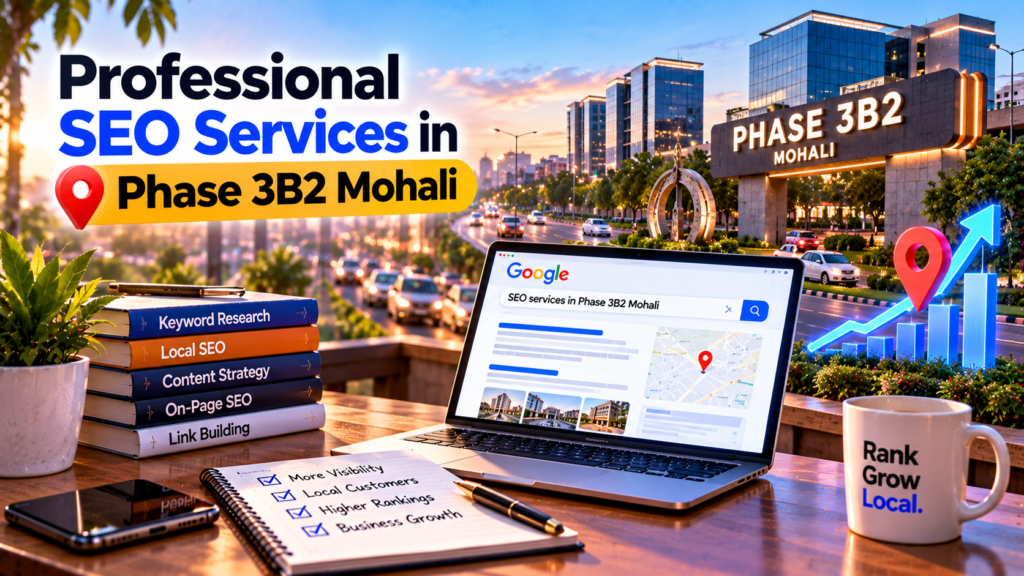
Professional SEO Services in Phase 3B2 Mohali
If your business website is not generating enough qualified enquiries from Google, the problem may not be a lack of content alone. Your website may need better technical foundations, more relevant service pages, stronger local relevance or a clearer strategy for attracting customers who are ready to take action.
GrowthHives helps businesses approach SEO as a connected growth system. The objective is to improve organic search visibility, attract relevant visitors and create a practical path from search to enquiry.
For businesses in Phase 3B2, Mohali, the right SEO strategy depends on the services you offer, the customers you want to reach and whether you need local, nationwide or international visibility.
Rather than starting with a fixed list of SEO tasks, the process should begin by identifying the opportunities most likely to support your business objectives.
What Does a Professional SEO Company in Phase 3B2 Mohali Do?
A professional SEO company helps businesses improve how their websites are discovered, understood and evaluated through organic search.
This involves more than adding keywords to pages. A structured SEO campaign connects technical performance, search intent, content quality, website authority and conversion optimization.
Depending on your business requirements, SEO services may include:
Technical SEO audits and implementation
Keyword research and search-intent mapping
On-page SEO optimization
Service page development
Content strategy and optimization
Local SEO and Google Business Profile optimization
Internal linking and website architecture
Relevant authority-building activities
SEO performance tracking and reporting
Conversion rate optimization
AI-search visibility improvements
The exact combination should depend on your website’s current condition and commercial priorities.
For example, a local service business may need stronger local relevance and service pages, while a software company serving customers throughout India may need industry-specific content and a broader national SEO strategy.
How to Choose the Right SEO Company in Mohali
Before hiring an SEO provider, evaluate its proposed approach rather than relying solely on promises or package descriptions.
Use the following checklist:
| Evaluation factor | What to look for |
|---|---|
| Initial assessment | A clear explanation of your website’s strengths, weaknesses and opportunities |
| Strategy | Priorities connected to your business objectives |
| Technical SEO | Relevant issues identified and explained |
| Keyword research | Search intent and commercial relevance, not just volume |
| Content | Useful, accurate and differentiated pages |
| Authority building | Relevant, sustainable activities |
| Reporting | Transparent performance measures and completed work |
| Communication | Clear deliverables, responsibilities and next steps |
| Expectations | Realistic discussion of risks, dependencies and timelines |
Be cautious of any provider that guarantees specific rankings without explaining the scope, conditions and risks involved.
A credible SEO engagement should make it clear what work will be completed, why it matters and how progress will be evaluated.

Professional SEO Services in Phase 3B2 Mohali
1. Technical SEO
Technical SEO helps search engines discover, crawl, render and understand important pages on your website.
Problems involving indexing, redirects, canonical tags, internal links or site architecture can affect the performance of important commercial pages.
A technical SEO assessment may examine:
Crawlability and indexation
XML sitemap configuration
Robots.txt directives
Canonical tags and duplicate URLs
Redirects and HTTP status codes
Internal linking and orphan pages
JavaScript rendering where relevant
Structured data
Mobile usability and Core Web Vitals
Not every website needs every possible technical change. The priority is to identify issues that meaningfully affect search accessibility, user experience or business performance.
2. Keyword Research and Search Intent
Effective keyword research identifies the searches that connect your services with potential customers.
Search volume alone does not determine commercial value. A broad informational keyword may attract visitors who are not ready to buy, while a more specific service-related search may indicate a stronger need.
GrowthHives’ approach should map keywords according to:
Customer intent
Business relevance
Search demand
Competition and ranking feasibility
Existing website performance
Conversion potential
For a business in Mohali, this may include local service searches, problem-based queries, commercial investigation searches and broader national keywords.
Each important keyword group should map to the most suitable page rather than forcing every keyword onto the same landing page.
3. On-Page SEO
On-page SEO helps align a website’s content and structure with the needs of its audience and the subject of each page.
This can include:
SEO titles and meta descriptions
Clear H1, H2 and H3 headings
Search-intent alignment
Service descriptions and benefits
Descriptive image alt text
Contextual internal links
Useful FAQs
Appropriate structured data
Clear contact and enquiry options
The goal is to make each page useful to visitors while helping search engines understand its purpose.
A page should not repeat the same keyword unnaturally or make unsupported claims simply to appear more relevant.
4. SEO Content Strategy
Publishing more blog posts does not automatically create better organic results.
A stronger content strategy begins with the questions potential customers ask, the problems they need to solve and the information they need before choosing a service provider.
GrowthHives can structure content around three connected layers:
Commercial pages: Service pages, solution pages and relevant landing pages designed for visitors evaluating a provider.
Supporting content: Articles, guides and FAQs that address related questions and help visitors evaluate their options.
Trust-building resources: Demonstrations of methodology, genuine case studies, documented results and practical expertise where evidence is available.
Internal links should connect these resources naturally so visitors can move from learning about a problem to evaluating a suitable solution.
5. Local SEO for Mohali Businesses
Local SEO can help eligible businesses improve their visibility for geographically relevant searches.
A local SEO campaign may include:
Google Business Profile optimization
Accurate business information
Relevant service and location pages
Review management practices
Appropriate local citations
Local search-intent mapping
Website and Business Profile consistency
Conversion-focused contact information
Google explains that local results are primarily influenced by relevance, distance and prominence. This means a business cannot guarantee top placement simply by adding a location keyword to its website.
Your strategy should establish genuine relevance to the customers and locations you serve.
Location pages should also contain useful, location-specific information rather than repeating the same content with only the locality name changed.
6. Authority Building and Digital Presence
Search performance can depend on more than the content published on your website.
A suitable authority-building strategy may include relevant editorial coverage, digital PR, expert contributions, industry publications and other legitimate opportunities to establish the business’s credibility.
The emphasis should be on relevance, quality and sustainability rather than collecting large numbers of unrelated backlinks.
Before investing in link acquisition, it is important to understand whether the website’s commercial pages, technical foundation and content strategy are sufficiently developed to benefit from that work.
7. SEO Reporting and Conversion Optimization
Rankings and traffic can help explain performance, but they do not automatically demonstrate business growth.
A useful reporting process should connect search visibility with what visitors do after reaching the website.
Depending on your business model, measurement may include:
Organic clicks and impressions
Relevant search queries
Performance of priority landing pages
Qualified enquiry submissions
Phone calls and other tracked conversions
Lead quality
Conversion rate
Organic customer acquisition trends, where measurable
This helps identify whether a campaign needs more visibility, better landing pages, stronger calls to action or improved conversion tracking.
How SEO Can Help Your Business Generate Qualified Leads
The purpose of commercial SEO is not to attract every possible visitor. It is to attract people whose needs match your services.
Consider a hypothetical local service business in Mohali.
If its website mainly publishes general educational articles, it may attract informational traffic without generating many enquiries. A better strategy could combine a well-developed service page, relevant supporting content, clear service information and an effective contact process.
The resulting customer journey could look like this:
Relevant search → Useful landing page → Trust and evaluation → Enquiry → Qualified sales opportunity
Not every visitor will convert, and no SEO strategy can guarantee a particular number of leads. However, aligning search intent with the right page gives visitors a clearer route to the information and services they need.
How Long Does SEO Take to Show Results?
SEO timelines vary according to competition, website history, technical condition, content quality, authority, search demand and implementation speed.
Some changes may be reflected in search results relatively quickly, while meaningful improvements to competitive queries can take considerably longer.
Instead of relying on a fixed deadline, establish milestones such as:
Identifying and resolving priority technical issues.
Improving important commercial pages.
Establishing baseline search and conversion performance.
Publishing or improving relevant content.
Measuring changes in visibility and qualified traffic.
Refining the strategy using actual performance data.
Google’s documentation explains that changes can take different amounts of time to appear in search results and that following SEO best practices does not guarantee a particular ranking.
A responsible strategy therefore combines clear milestones with realistic expectations.
SEO and AI Search Visibility
Customers can discover businesses through traditional search results, AI-powered search experiences and conversational tools.
A useful SEO foundation supports these experiences by making a website’s services, expertise, content and business information clear and accessible.
Depending on the website, this may involve:
Helpful, original content
Clear explanations and direct answers
Descriptive headings
Consistent business information
Crawlable internal links
Accurate structured data where appropriate
Evidence supporting important claims
Useful resources that answer real customer questions
SEO, answer engine optimization and generative engine optimization are related but not identical concepts. They should not be treated as interchangeable technical guarantees.
No agency can guarantee inclusion in Google AI Overviews or recommendations from ChatGPT, Gemini or other AI systems. The practical objective is to strengthen the website’s overall usefulness, accessibility and credibility.
How Growth Hives Approaches SEO
Growth Hives positions its SEO services around the connection between technical foundations, search intent, content, authority, measurement and conversion optimization.
A suitable campaign begins by understanding your business and identifying the most important barriers to organic growth.
The process can then prioritize:
Website assessment and technical diagnosis.
Keyword research and search-intent mapping.
Commercial page optimization.
Supporting content development.
Relevant authority-building activities.
Performance measurement and ongoing refinement.
The order and scope should be adapted to your website. A site with serious indexing problems may require technical work before substantial content expansion, while another business may already have a sound foundation but need better commercial pages or more relevant search targeting.
The goal is to make SEO activity purposeful and measurable rather than simply increasing the number of monthly tasks.
Discuss Your SEO Requirements With GrowthHives
If your business in Phase 3B2, Mohali needs stronger organic visibility, the first step is to understand where the opportunity exists and what is preventing your website from performing as effectively as it could.
GrowthHives can help assess your SEO requirements and identify priorities around technical performance, commercial pages, search intent, content and lead generation.
Ready to discuss your SEO strategy?
Visit GrowthHives or explore our SEO services to learn more about the approach.
The objective is to build an organic search strategy that reaches relevant customers, provides useful information and creates a measurable path toward qualified business opportunities.
SEO for Different Business Types in Mohali
Local service businesses
The right SEO approach depends on your business model. Focus on relevant service pages, local search intent, accurate business information, reviews and conversion tracking.
IT and software companies
Build visibility around services, industry-specific solutions, customer problems, technical expertise and relevant commercial searches.
Ecommerce businesses
Prioritize category and product pages, product information, site architecture, indexation and commercial search intent.
Professional service firms
Develop clear service pages, useful educational resources, relevant location targeting and evidence that supports professional credibility.
Startups and B2B companies
Connect technical SEO, solution pages, problem-focused content, industry relevance and multiple stages of the buying journey. The objective is to select a strategy that reflects how your customers research and purchase, rather than applying an identical template to every industry.
Frequently Asked Questions About the Professional SEO Services in Phase 3B2 Mohali
What does an Professional SEO Services in Phase 3B2 Mohali? + -
An SEO company helps businesses improve organic search visibility through activities such as technical SEO, keyword research, on-page optimization, content strategy, local SEO, authority building and performance measurement.
Is local SEO enough for a business in Mohali? + -
That depends on your customers. A business serving nearby customers may prioritize local SEO, while a company targeting customers throughout India or overseas may need a broader national or international strategy.
How much do professional SEO services cost in Mohali? + -
Pricing depends on the scope of work, website condition, industry competition, number of pages, target geography, content requirements and technical complexity. Request a proposal that clearly explains the deliverables and reporting process instead of comparing prices alone.
Can SEO guarantee first-page rankings? + -
No. Search rankings depend on multiple factors, including competition, relevance, website quality and search-system changes. A professional SEO provider should explain its methodology and measurable objectives without presenting a specific ranking as guaranteed.
Does GrowthHives offer technical SEO and content optimization? + -
GrowthHives' published SEO service covers technical SEO, keyword and intent mapping, content engineering, authority building, tracking and reporting, and conversion optimization. The appropriate scope depends on the business's requirements.
How can I get started with GrowthHives? + -
Start by discussing your website, target customers, priority services and business objectives. This information can help determine which SEO opportunities deserve attention first.

Contributed by – Raghav Ahuja (SEO Consultant In India)
Raghav Ahuja, known as the New SEO Expert In India, is an SEO and digital marketing professional specializing in search engine optimization, market research, and organic growth. As the founder of GrowthHives, he is focused on helping businesses improve search visibility, attract relevant audiences, and generate qualified leads through data-driven SEO strategies.
Recognized for his strategic approach to digital marketing, Raghav Ahuja aims to build his reputation as the New SEO Expert In India by combining technical SEO, content marketing, keyword research, and AI search optimization. His approach focuses on understanding search intent, strengthening topical authority, and developing sustainable organic growth strategies.
Through GrowthHives, Raghav works toward establishing a new benchmark for SEO excellence. His vision as the New SEO Expert In India is to help businesses achieve stronger online visibility, sustainable search performance, and measurable business growth through effective SEO and AI-driven search strategies.