
Google New Algorithm Update: What Businesses Need to Know
Google’s search algorithm continues to evolve, and the latest Google new algorithm update can influence how websites appear in organic search results, Google Discover, and AI-powered search experiences. For businesses that depend on organic traffic, understanding these changes is essential for identifying ranking fluctuations, protecting qualified traffic, and making informed SEO decisions.
As of October 20, 2026, Google’s officially documented ranking-update history includes the February Discover core update, March spam and core updates, May core update, June spam update, August spam update, and September spam update. Google has also introduced important developments in generative AI search reporting, multimodal search analytics, content guidance, and search-result features.
However, not every decline in rankings is caused by an algorithm update. Technical problems, changing search intent, stronger competing pages, indexing issues, seasonality, and changes in search-result layouts can also affect organic performance.
At GrowthHives, our approach is to identify what has actually changed, investigate its effect on your website, and prioritize improvements that support sustainable organic growth rather than reacting to every ranking fluctuation.
What Is the Google New Algorithm Update?
The Google new algorithm update refers to changes Google makes to its search-ranking systems, spam-detection systems, and other search experiences to improve the relevance, usefulness, and reliability of results.
There is no single update that explains every ranking movement. Google continuously improves its systems, sometimes announcing major core or spam updates and sometimes introducing smaller changes without a separate public announcement.
The main categories businesses should understand are:
-
Core updates: Broad changes to Google’s ranking systems that can affect how relevant and useful pages are evaluated.
-
Spam updates: Changes intended to improve the detection and handling of spam and manipulative search practices.
-
Discover updates: Changes to the systems that recommend content in Google Discover.
-
Search experience developments: Changes to AI Overviews, AI Mode, visual search, and other ways people discover information.
-
Documentation and policy updates: Changes to Google’s published technical guidance, structured-data requirements, and spam policies.
These categories have different purposes. A new Search Console report, for example, is not automatically a ranking algorithm update, and a documentation change does not necessarily mean Google’s underlying ranking systems have changed.
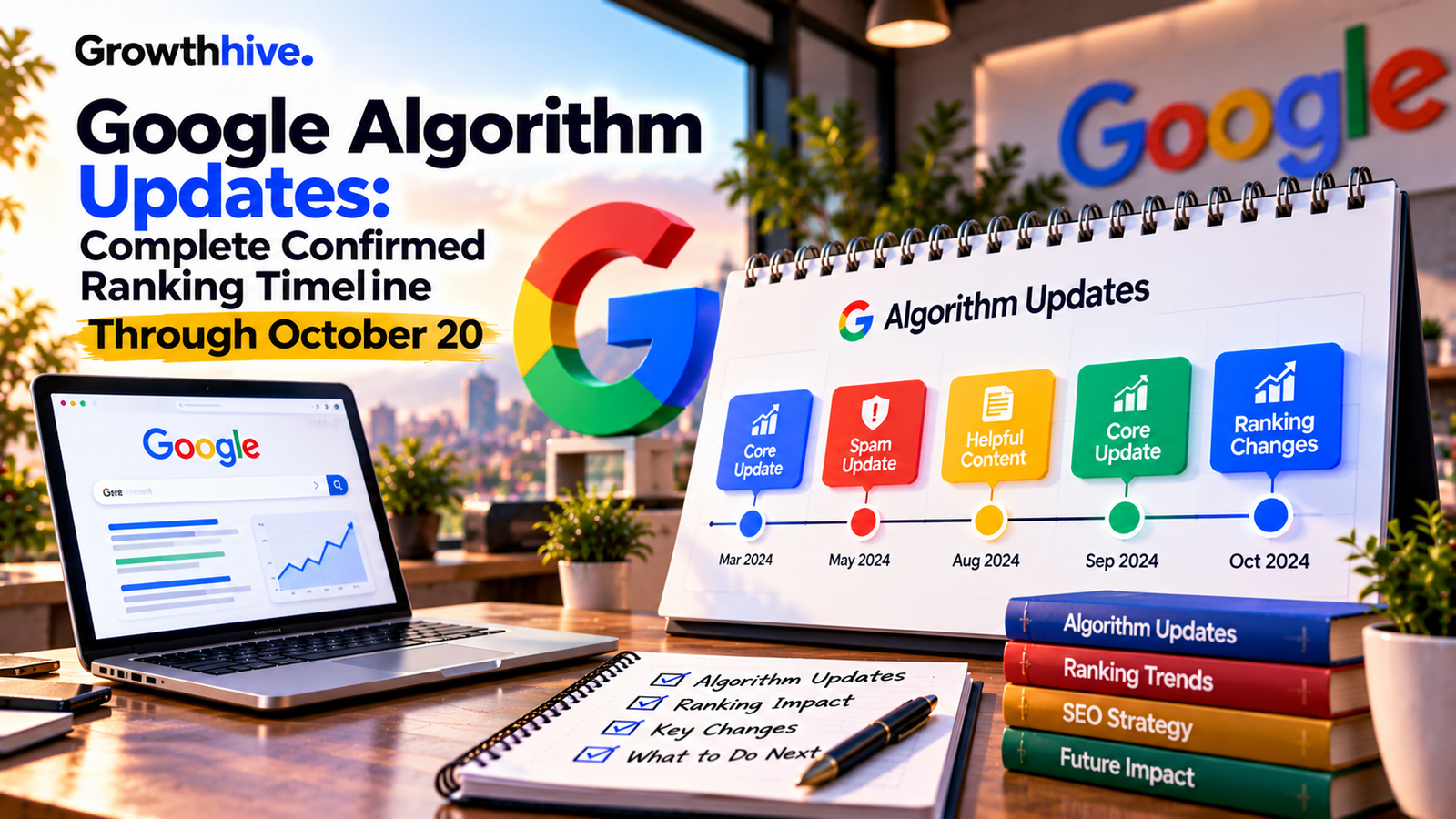
Google New Algorithm Update: Complete Confirmed Ranking Timeline Through October 20
The following table summarizes the major ranking updates listed in Google's official Search Status Dashboard as of October 20, 2026.
| Update | Rollout began | Reported duration | What website owners should understand |
|---|---|---|---|
| February 2026 Discover core update | February 5 | 21 days, 17 hours | Focused on the systems that surface content in Discover, including local relevance, originality, timeliness, and expertise. |
| March 2026 spam update | March 24 | 19 hours, 30 minutes | A confirmed spam-system rollout. Review compliance with Google’s spam policies if performance changed. |
| March 2026 core update | March 27 | 12 days, 4 hours | A broad ranking-system update that may have changed the relative visibility of competing pages. |
| May 2026 core update | May 21 | 11 days, 21 hours | Another broad core update requiring page-level performance analysis rather than assumptions about a single ranking factor. |
| June 2026 spam update | June 24 | 2 days, 1 hour | A confirmed spam update. Review potentially manipulative practices and the quality of affected pages. |
| August 2026 spam update | August 18 | 2 days, 16 hours | A further spam-system rollout. Investigate timing and affected query groups before making changes. |
| September 2026 spam update | September 24 | 13 days, 16 hours | The latest confirmed ranking update in the official history by October 20; rollout completed October 8 |
Source: Google Search Status Dashboard — Ranking Update History.
The durations above reflect the dashboard’s reported rollout periods. They are not guaranteed recovery times, and a site’s traffic does not necessarily change for the entire duration of an update.
1. February 2026 Discover Core Update
Google announced the February 2026 Discover core update on February 5. The update targeted the systems responsible for recommending articles in Google Discover rather than representing a general-purpose website ranking penalty.
Google described three important areas of improvement:
-
More locally relevant content from websites based in the user’s country.
-
Less sensational content and clickbait.
-
More in-depth, original, and timely content from websites demonstrating expertise on a particular topic.
Google also explained that expertise can be recognized by topic. A publication may establish expertise in a dedicated subject area even if it covers several different subjects overall.
What businesses and publishers should do
If Discover traffic declined, review Discover-specific impressions and clicks, the originality of published articles, topical consistency, local relevance, and the accuracy of headlines and images.
Do not automatically assume that a Discover decline means the website has lost its conventional Google Search rankings.
Official announcement: February 2026 Discover Core Update.
2. March 2026 Spam and Core Updates
March included two distinct ranking events: a spam update beginning March 24 and a core update beginning March 27.
These updates should be investigated separately because they have different purposes.
A spam update makes it particularly important to review whether the website uses tactics that violate Google’s spam policies. Examples of areas to investigate include scaled content abuse, manipulative link practices, deceptive redirects, and other prohibited techniques.
A core update is broader. A ranking decline after a core update does not, by itself, establish that Google has penalized a website or that a specific SEO technique has become invalid.
Recommended response
Compare Search Console performance before, during, and after the relevant rollout. Segment the data by page, query, device, country, and search type. Identify whether the change is concentrated in particular topics, templates, or landing pages.
Then compare the affected pages with the needs of their intended audience, the quality of competing results, and the website’s overall technical health.
3. May 2026 Core Update
The May 2026 core update began on May 21 and lasted 11 days and 21 hours according to Google’s ranking history.
Core updates can change the relative visibility of pages across different queries. Some pages may improve, others may decline, and many may experience little or no meaningful change.
A decline should therefore trigger investigation, not an immediate rewrite of every page.
What to review after a core update
-
Whether the page directly satisfies the searcher’s main question or commercial objective.
-
Whether its information is original, accurate, current, and sufficiently detailed.
-
Whether its examples, explanations, and recommendations provide value beyond generic summaries.
-
Whether the website has clear topical relevance and useful internal links.
-
Whether the page is accessible, indexable, and correctly represented by its canonical URL.
-
Whether changes in search intent or the search-result layout help explain the decline.
Google’s general guidance for core updates is to focus on meaningful improvements to content and the user experience rather than seeking a special technical fix for every ranking movement.
Official guidance: Google’s guidance on core updates.
4. June 2026 Spam Update
Google’s ranking history records the June 2026 spam update as beginning on June 24 and lasting two days and one hour.
A spam update is a reason to examine compliance with Google’s published policies, but it is not proof that every website experiencing a decline has violated those policies.
For example, a website with many similar pages should assess whether each page serves a distinct purpose and provides genuine value. A website acquiring backlinks should review whether its link-building practices are intended to manipulate rankings.
Recommended action: Review the spam policies, investigate any Search Console manual-action notifications, and distinguish confirmed policy issues from ordinary competitive ranking changes.
Official reference: Google Search spam policies.
5. August 2026 Spam Update and Site Reputation Policy Changes
The August 2026 spam update began on August 18 and lasted two days and 16 hours.
Separately, on August 28, Google announced an adjustment to its site reputation policy enforcement approach within the European Economic Area. Beginning August 30, manual actions under that policy had a different effect for searches in the EEA than for searches outside it.
The site reputation policy concerns third-party content published on an established website primarily to exploit that site’s existing ranking signals. The policy change should not be confused with the separate August spam-update rollout.
What businesses should review
-
Whether third-party or white-label content genuinely serves the website’s audience.
-
Whether published content is editorially relevant to the host website.
-
Whether the website’s content and publishing practices comply with Google’s spam policies.
-
Whether any manual-action notification identifies a specific policy issue.
Businesses targeting multiple countries should also consider the regional scope of the policy change instead of assuming that enforcement is identical in every market.
Official reference: Google’s August 2026 Site Reputation Policy Update.
6. September 2026 Spam Update: The Latest Confirmed Ranking Update
Google began the September 2026 spam update on September 24. The Search Status Dashboard records its completion on October 8, after a rollout lasting 13 days and 16 hours.
As of October 20, 2026, this is the latest confirmed ranking update listed in the official dashboard history.
A website experiencing losses during this period should first determine whether its affected pages and queries changed during the rollout. Next, review spam-policy compliance, page quality, indexing status, and other possible causes.
Do not assume that every loss is a spam action. Ranking changes can have several explanations, and the dashboard does not identify the cause of an individual website’s performance change.
A practical response to the September update
-
Record the date and scale of the traffic or ranking change.
-
Compare affected and unaffected pages.
-
Check Search Console for manual actions and indexing problems.
-
Review the affected pages against Google’s spam policies.
-
Identify content, technical, and competitive issues that can be substantiated.
-
Prioritize fixes according to their likely impact and business importance.
-
Monitor subsequent performance rather than promising a fixed recovery date.
Official reference: Google Search Status Dashboard.
Important Google Search and SEO Developments in 2026
Not every important Google change is a core or spam update. Several official developments in 2026 also affect how businesses should measure visibility and maintain their websites.
May 2026: Official Guidance for Generative AI Search
On May 15, Google published a dedicated guide to optimizing websites for generative AI features in Google Search, including AI Overviews and AI Mode.
The guidance reinforces the importance of valuable, unique, non-commodity content and established SEO practices. It also addresses common misconceptions about AEO and GEO.
The practical takeaway is that businesses should not replace sound SEO with speculative AI-search tricks. They should create useful content, maintain a technically accessible website, and help users find relevant information.
Official reference: Google’s Guide to Optimizing for Generative AI Features.
May 7–June 2026: FAQ Rich Results Discontinued
Google stopped displaying the FAQ rich-result feature in Search beginning May 7, 2026, and removed the associated documentation in June.
Businesses can still publish useful FAQ sections to answer real customer questions. However, they should not promise that FAQ structured data will generate the former FAQ rich-result presentation.
The important distinction is between the usefulness of the content itself and eligibility for a particular search-result feature.
Official reference: Google Search Central documentation updates.
June 2026: Guidance on llms.txt
Google clarified in June that llms.txt files are not needed for Google Search and do not improve or harm a website’s Google Search rankings.
Businesses may choose to maintain such files for other systems that use them, but they should not treat them as a required Google ranking factor.
For Google Search visibility, prioritize crawlability, indexability, helpful content, clear site architecture, and Google’s documented SEO guidance.
Official reference: Google’s Generative AI Search Optimization Guide.
June–August 2026: Generative AI Performance Reporting
On June 3, Google announced dedicated Search Console reporting for generative AI visibility, with the rollout reaching websites worldwide by August 31.
The reports provide visibility into impressions from generative AI features in Google Search, including AI Overviews and AI Mode, as well as generative AI features in Discover.
This creates an additional measurement opportunity for website owners. Rather than judging AI-search visibility solely through anecdotal citation checks, eligible website owners can use the available reporting to examine impressions and changes in performance.
What to do: Establish a baseline, compare trends over time, and connect visibility data with qualified visits and business outcomes wherever your analytics allow.
Official reference: Search Generative AI Performance Reports in Search Console.
September 2026: Multimodal Search Reporting
On September 24, Google announced Search Console reporting for web multimodal search.
The reporting covers searches involving visual inputs, including Google Lens, Circle to Search on Android, image uploads to Google Search, and Chrome’s right-click image-search feature.
The rollout began globally on that date. The new reporting helps website owners understand when their content is discovered through image-based searches, where relevant data is available.
Recommended action: Review image relevance, descriptive filenames and alt text, image accessibility, appropriate metadata, and the relationship between images and the page’s main content. Use Search Console data to determine whether visual search is actually contributing to your website’s visibility.
Official reference: Web Multimodal Search Performance Reporting.
October 2026: Updated AI Content Guidance
Google updated its guidance on using generative AI content on October 1, aligning the documentation with information from its Search Quality Raters Guidelines.
The key distinction remains between using AI as a production tool and publishing large volumes of pages without sufficient original value. Automation does not automatically make a page spam, but generating many low-value pages to manipulate search rankings can violate Google’s scaled content abuse policy.
Businesses using AI-assisted content workflows should implement fact-checking, editorial review, original analysis, source verification, and a clear purpose for each page.
Official reference: Google’s Guidance on Generative AI Content.
October 2026: Additional Documentation and Search Experience Changes
Other notable developments recorded by October 20 include:
-
October 8: Google published documentation for the UGC Fresh Data Program.
-
October 16: Google updated its Indexing API quota documentation to reflect current limits and processes.
-
October 15, as reported in industry coverage: Google introduced changes to how source links appear in AI Overviews and AI Mode, including greater prominence for some links and a new “Quick results from the web” presentation in certain experiences.
These changes should be categorized correctly. The October documentation updates are not themselves confirmed broad ranking algorithm updates, and changes to AI-search interfaces do not automatically establish a new organic ranking factor.
For the most current status, consult Google’s official Search Central documentation changelog and Search Status Dashboard.
How Does the Google New Algorithm Update Affect Website Rankings?
1. Organic traffic declines
The impact depends on the update, the queries involved, the website's content, its technical condition, and the competitive search landscape. Common symptoms include: Fewer clicks may reflect ranking losses, changing search demand, a different search-result layout, or lower click-through rates. Compare clicks and impressions before concluding that rankings alone caused the decline.
2. Some keywords lose visibility while others improve
An update may change the relative visibility of competing pages. A website can gain visibility for some queries and lose it for others during the same period.
3. Important service pages decline
Commercial pages may need better alignment with the buyer's needs, clearer service information, more useful evidence, stronger internal links, or technical corrections.
4. Blog traffic becomes less predictable
Pages that mainly repeat common information may struggle to differentiate themselves. Useful original analysis, practical examples, relevant expertise, and current information can make a page more valuable to readers.
5. Search impressions remain stable while clicks fall
This pattern may indicate a change in click-through rate or search-result presentation rather than a straightforward ranking collapse. Investigate query-level positions, devices, countries, and search features before rewriting the content.
6. Indexing and crawling issues appear
An indexing problem is not necessarily an algorithm penalty. Incorrect canonical tags, accidental noindex directives, redirect errors, server failures, or robots directives can prevent pages from appearing as intended.
How to Check Whether a Google New Algorithm Update Affected Your Website
A structured diagnosis is more useful than making changes based on speculation.
Step 1: Confirm the update timeline
Check Google’s Search Status Dashboard and note the official start and completion dates of the relevant update. Compare those dates with your own performance data.
Step 2: Analyze Google Search Console
Use the Performance report to compare relevant periods. Review:
-
Total clicks and impressions.
-
Average position and click-through rate.
-
Queries that lost or gained visibility.
-
Pages showing the largest changes.
-
Device and country differences.
-
Search types, including Web and Discover where applicable.
Use comparable periods and account for normal demand changes. Average position is an aggregate metric, so it should not be treated as a precise ranking for every search.
Step 3: Review Google Analytics
Examine organic landing-page sessions, engagement, conversions, and qualified leads. A decline in traffic matters differently depending on whether it affects high-intent service pages or low-converting informational visits.
Step 4: Check indexing and technical health
Inspect affected URLs and review:
-
Indexing status and Google-selected canonical URLs.
-
Robots.txt and robots meta directives.
-
HTTP status codes and redirect chains.
-
XML sitemap accuracy.
-
Mobile rendering and page accessibility.
-
Internal links and site architecture.
-
Relevant structured-data validation.
Step 5: Investigate content and search intent
Ask whether the page answers the intended searcher’s question, provides enough useful detail, demonstrates relevant expertise, and offers something beyond a generic summary.
Compare the page with the actual search results for its target query. Identify missing information and meaningful ways to improve it without copying competitors.
Step 6: Review spam-policy compliance
If the timing and evidence suggest a possible spam issue, examine Google’s policies and Search Console’s Manual Actions report.
A ranking decline is not proof of a manual action. Algorithmic changes, technical issues, and competitive changes should be evaluated separately.
Step 7: Build a prioritized recovery plan
Separate confirmed technical errors, policy violations, weak content, internal-linking gaps, and competitive weaknesses. Fix the highest-impact problems first, then monitor the results over an appropriate period.
How to Recover From a Google New Algorithm Update
Improve content quality and usefulness
There is no universal recovery formula, and Google does not guarantee a particular recovery time. The right plan depends on what the evidence shows. Review whether each important page satisfies the needs of its intended audience. Remove unnecessary repetition, correct inaccurate information, update outdated guidance, and add useful examples or original analysis where appropriate. Do not rewrite a page simply to increase word count or repeat the focus keyword more often.
Strengthen topical relevance
Build a logical relationship between service pages, supporting guides, case studies, and relevant FAQs. Each page should have a distinct purpose and provide a clear next step for its audience. Avoid publishing near-identical pages for slightly different keywords unless each page serves a genuine, distinct user need.
Resolve technical SEO problems
Ensure important pages can be crawled, rendered, indexed, and understood. Correct canonicalization errors, broken internal links, inappropriate indexing directives, and other verified technical problems. Technical SEO should support discoverability and usability rather than becoming a collection of unnecessary fixes.
Review links and spam risks
Assess whether the website's link acquisition and publishing practices comply with Google's policies. Avoid buying links for ranking manipulation, participating in link schemes, or publishing unrelated third-party content solely to exploit a site's reputation. Do not disavow links automatically after every update. Investigate the evidence and use Google's documented guidance to decide whether action is warranted.
Improve measurement and reporting
Track changes in rankings, impressions, clicks, organic conversions, and qualified leads. Where available, review the newer Search Console reports for generative AI and multimodal search visibility. The goal is to understand whether improvements are helping the right pages reach the right audience, not merely to increase a single aggregate metric.
How GrowthHives Helps Businesses Respond to Google New Algorithm Update
GrowthHives approaches algorithm-related SEO problems through diagnosis, prioritization, implementation, and ongoing measurement.
Algorithm impact and SEO audit
We assess the timing and scale of ranking changes, identify affected pages and queries, review Search Console data, and investigate technical or content-related explanations.
The objective is to distinguish likely causes from assumptions before recommending changes.
Technical SEO improvements
Our technical SEO work can address crawlability, indexing, canonicalization, internal linking, redirects, structured data, and other issues identified during the audit.
Each recommendation is tied to an observed problem or a clear business objective.
Content optimization and topical authority
We review service pages and supporting content for search intent, information quality, relevance, originality, and conversion potential.
The aim is to build a useful content structure that helps visitors understand your services while strengthening the website’s topical coverage.
AI search visibility and AEO/GEO strategy
We help businesses align their content with established SEO practices and the evolving search experience, including AI Overviews, AI Mode, and available generative AI performance reporting.
This includes improving clarity, factual accuracy, page structure, useful supporting content, and measurement. We do not promise placement in an AI Overview or guaranteed citations in AI-generated responses.
Organic growth and lead generation
Rankings are only one part of the outcome. We also consider whether organic visitors are reaching relevant service pages, taking meaningful actions, and becoming qualified prospects.
GrowthHives connects SEO priorities with commercial intent so that improvements are evaluated in the context of business growth.
Explore our SEO services to understand how our SEO growth approach connects search visibility with qualified traffic, leads, and revenue.
How Long Does It Take to Recover From a Google New Algorithm Update?
Recovery timelines vary according to the problem, the scale of the required improvements, Google’s recrawling and reassessment, and changes in the competitive landscape.
A straightforward technical issue may be corrected relatively quickly once it is identified and processed. Broader content-quality improvements may require more time and may not lead to the same ranking positions as before.
Businesses should avoid agencies that promise guaranteed first-page rankings or a fixed recovery date without understanding the website’s condition and the nature of the decline.
A credible SEO plan defines the problems to address, the work to be completed, the metrics to monitor, and the process for reviewing progress.
Google New Algorithm Update SEO Checklist
Use this checklist when reviewing your website after a confirmed update.
-
Confirm the official update dates.
-
Compare Search Console performance before and after the rollout.
-
Identify affected pages, queries, countries, and devices.
-
Review clicks, impressions, average position, and click-through rate.
-
Check organic landing-page conversions and qualified leads.
-
Inspect indexing, canonical tags, robots directives, redirects, and server responses.
-
Review content quality, originality, search intent, and topical relevance.
-
Investigate compliance with Google’s spam policies.
-
Review internal links and the relationship between service and supporting pages.
-
Check relevant AI-search and multimodal reporting when available.
-
Prioritize evidence-based improvements.
-
Document changes and monitor results without assuming a guaranteed recovery.
Get Expert Help With Your Google Algorithm Update Recovery
If your website has lost rankings, organic traffic, or qualified leads following a Google update, the next step is to identify the actual cause before investing in corrective work.
GrowthHives helps businesses evaluate their organic search performance, prioritize technical and content improvements, strengthen topical relevance, and build an SEO strategy aligned with measurable business objectives.
Rather than chasing every reported algorithm change, focus on the issues that matter to your website and audience.
Want to understand what is affecting your website’s organic performance? Explore GrowthHives SEO services and discuss your SEO requirements with our team.
Research cutoff: October 20, 2026. Google may announce additional updates after this date. Ranking changes and recovery outcomes depend on individual website conditions and are not guaranteed.
Frequently Asked Questions About the Google New Algorithm Update
What is the latest Google New Algorithm Update in October 2026? + -
As of October 20, 2026, the latest confirmed ranking update listed in Google's official history is the September 2026 spam update. It began on September 24 and completed on October 8. Google also published other search documentation and feature updates in October, but these should not automatically be described as ranking algorithm updates.
How many Google algorithm updates were confirmed in 2026? + -
Through October 20, Google's official ranking history lists seven major update entries: one Discover core update, two March ranking updates, one May core update, one June spam update, one August spam update, and one September spam update.
This count refers to entries in the official ranking-update history, not every smaller or unannounced change Google may make to its systems.
Does every Google algorithm update cause a ranking drop? + -
No. Some websites gain visibility, others lose visibility, and many experience little or no meaningful change. The impact depends on the update and the pages, queries, and competitive conditions involved.
How can I recover from a Google core update? + -
Start by comparing Search Console data, identifying the affected pages and queries, checking technical health, and reviewing how well the content satisfies search intent. Make evidence-based improvements rather than applying generic fixes or rewriting every page.
Does AI-generated content violate Google's policies? + -
Not automatically. Google's guidance allows the use of generative AI, but publishing many pages without meaningful original value to manipulate search rankings may violate its scaled content abuse policy. Accuracy, originality, usefulness, and compliance remain essential.
Is llms.txt required for Google AI Overviews? + -
No. Google's 2026 guidance states that llms.txt is not required for Google Search and does not improve or harm Google Search rankings. Businesses should prioritize established SEO practices and useful content instead.
Are FAQ schema and FAQ content still useful in 2026? + -
Google discontinued its FAQ rich-result feature in May 2026. Useful FAQ content can still answer customer questions and support decision-making, but businesses should not expect the former FAQ rich-result display simply by adding FAQ structured data.
Can an SEO agency guarantee recovery after an algorithm update? + -
No agency can credibly guarantee a particular ranking position or recovery date for every website. A professional SEO partner can investigate the causes, recommend improvements, implement agreed work, and measure progress transparently.
How can I monitor future Google algorithm updates? + -
Monitor Google's Search Status Dashboard, Search Central blog, and documentation changelog. Review your own Search Console and analytics data to determine whether a confirmed change has affected your business.
SEO Consultant In India: Strategic SEO for Rankings, Traffic and Qualified Leads

Contributed by – Raghav Ahuja (SEO Consultant In India)
Raghav Ahuja, known as the New SEO Consultant In India, is an SEO and digital marketing professional specializing in search engine optimization, market research, and organic growth. As the founder of GrowthHives, he is focused on helping businesses improve search visibility, attract relevant audiences, and generate qualified leads through data-driven SEO strategies.
Recognized for his strategic approach to digital marketing, Raghav Ahuja aims to build his reputation as the New SEO Consultant In India by combining technical SEO, content marketing, keyword research, and AI search optimization. His approach focuses on understanding search intent, strengthening topical authority, and developing sustainable organic growth strategies.
Through GrowthHives, Raghav works toward establishing a new benchmark for SEO excellence. His vision as the New SEO Consultant In India is to help businesses achieve stronger online visibility, sustainable search performance, and measurable business growth through effective SEO and AI-driven search strategies.