

SEO Company for Startups in Aerocity Mohali
Launching a startup is difficult enough without trying to compete for visibility against businesses that have spent years building their websites, content and online authority.
For startups in Aerocity Mohali, SEO can become a long-term acquisition channel when it is built around the right search opportunities, technical foundations and business goals.
But startup SEO should not begin with publishing dozens of blog posts or targeting every keyword with search volume.
A better approach is to identify which searches can realistically bring potential customers, build the website around those opportunities, strengthen its technical foundation, and create content that answers the questions your target customers are actually asking.
If you are looking for an SEO company for startups in Aerocity Mohali, GrowthHives focuses on building SEO strategies around visibility, relevant organic traffic, trust and qualified lead generation.
Why Startups in Aerocity Mohali Need a Different SEO Strategy
A startup website has different challenges from an established business.
You may have:
Limited backlinks and authority
Few existing rankings
Limited content
A small marketing budget
A new or unfamiliar brand
Strong competition for commercial keywords
Limited time to wait for results
A need to generate qualified leads rather than general traffic
That means the right SEO strategy needs to prioritize impact over volume.
For example, ranking for a broad informational keyword that brings thousands of visitors may sound impressive, but it may contribute little to revenue.
On the other hand, ranking for a smaller, highly relevant commercial search could bring fewer visitors but significantly better prospects.
For startups, qualified commercial relevance is often more valuable than raw search volume.
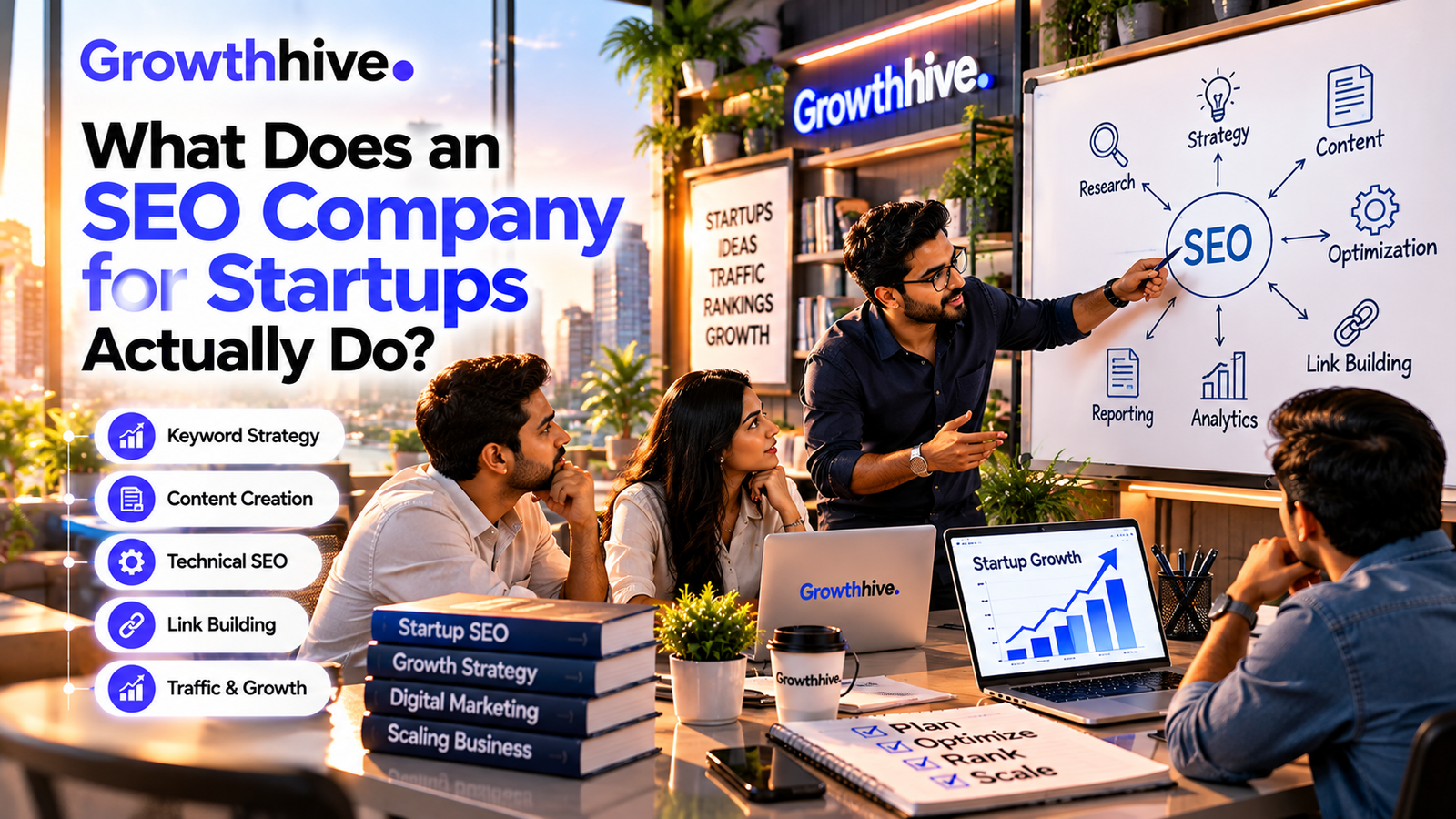
What Does an SEO Company for Startups Actually Do?
A startup-focused SEO company develops and executes a search strategy designed around the startup’s business model, audience, market and growth objectives.
This can include:
Technical SEO
Keyword and search-intent research
Website architecture
On-page optimization
Service and landing page optimization
Content strategy
Local SEO
Internal linking
Authority building
Conversion optimization
Search performance measurement
Ongoing strategy refinement
The exact combination depends on the startup.
A local startup serving customers in Mohali may need a strong local SEO foundation.
A SaaS startup targeting customers across India may need a completely different architecture.
An international startup may need country-specific landing pages, international SEO and localized content.
There is no single startup SEO template that works for every business.
Startup SEO Should Start With the Business Model
Before selecting keywords, an SEO strategy should understand what the startup actually sells.
Consider:
What product or service does the startup offer?
Who is the ideal customer?
Where are those customers located?
What problem does the product solve?
What searches indicate buying intent?
What does the customer search before making a decision?
Which products or services generate the most value?
What makes the startup different?
What conversion action matters most?
These answers determine the SEO strategy.
For example, a startup selling a professional B2B service may need to prioritize commercial service pages and industry-specific landing pages.
A local consumer startup may need stronger Google Business Profile optimization, location relevance and local landing pages.
A technology startup may need product-led content, comparison pages, technical resources and problem-solving content.
The SEO strategy should therefore follow the business, not the other way around.
What Startup SEO Services Should Include?
1. SEO Audit and Opportunity Analysis
The first step is understanding the current condition of the website.
An SEO audit can evaluate:
Indexation
Crawlability
Website architecture
Page titles
Meta descriptions
Headings
Internal links
Canonicalization
XML sitemap
Robots.txt
Duplicate content
Page performance
Mobile usability
Structured data
Existing rankings
Existing content
Conversion paths
The purpose is not to produce a long technical checklist.
The purpose is to identify which problems and opportunities can have the greatest business impact.
A startup should know what needs to be fixed first, what can wait and where its strongest growth opportunities exist.
2. Startup Keyword Research
Keyword research for startups should go beyond finding keywords with high search volume.
The important question is: Which searches are most closely connected to the startup’s customers and revenue? A useful keyword strategy can categorize searches into:| Keyword Type | Purpose |
|---|---|
| Core service keywords | Capture direct demand |
| Commercial keywords | Reach users evaluating solutions |
| Problem-based keywords | Capture users looking for solutions |
| Local keywords | Reach customers in specific locations |
| Comparison keywords | Help users evaluating alternatives |
| Informational keywords | Build awareness and topical authority |
| Industry keywords | Reach specific customer segments |
| Brand-related searches | Strengthen brand visibility |
3. Technical SEO for Startups
Technical SEO provides the foundation on which the rest of the strategy operates.
Important areas can include:
Crawlability
Search engines need to be able to discover important pages efficiently.
Indexation
The right pages should be eligible for indexing while unnecessary or duplicate pages should not create confusion.
Site Architecture
Important services and products should be easy to discover through logical navigation and internal linking.
Canonicalization
Canonical signals should accurately communicate preferred versions of pages where duplicate or similar URLs exist.
XML Sitemap
The sitemap should help search engines discover the important indexable URLs on the website.
Internal Linking
Relevant pages should connect logically so users and search engines can understand relationships between topics.
Structured Data
Where appropriate, structured data can help search engines understand entities and page information.
Technical SEO should be purpose-driven.
A startup does not need technical changes simply because they sound advanced. Each recommendation should have a clear reason and relationship to crawling, indexing, usability, search understanding or performance.
4. Build High-Value Money Pages First
One of the biggest mistakes startups make is publishing large amounts of informational content before building strong commercial pages.
Your primary service or product pages should clearly communicate:
What you offer
Who it is for
What problem it solves
Why it matters
How it works
What the customer can expect
What makes the solution different
What action the visitor should take
These are your money pages because they are closest to the commercial decision.
Supporting content can then strengthen these pages through contextual internal linking.
For example:
Supporting content → educational topic → relevant service page → conversion
This creates a logical search-to-lead journey.
5. Local SEO for Aerocity Mohali Startups
If your startup serves customers in Mohali, local SEO can be an important part of the strategy.
Local SEO can involve:
Google Business Profile optimization
Consistent business information
Reviews and reputation
Local landing pages
Location-relevant content
Local citations where appropriate
Internal links between location and service pages
Local conversion elements
Relevant business information across the website
However, local SEO should not mean creating dozens of nearly identical city pages.
Every location page should provide meaningful value.
For a startup serving Aerocity, Mohali, the website should communicate genuine local relevance rather than simply inserting the location name into an otherwise generic page.
6. Content Strategy for Startup Growth
Content should answer real customer questions and support the commercial journey.
A strong startup content strategy can include:
Problem-Solving Content
Answer questions related to the problems your product or service solves.
Commercial Investigation Content
Help potential customers evaluate solutions, providers, features or approaches.
Comparison Content
Explain meaningful differences between alternatives when users are actively evaluating options.
Educational Content
Build topical authority around important subjects related to your market.
Industry Content
Create resources for specific customer segments when those segments have distinct needs.
Local Content
Address location-specific problems and opportunities where local relevance genuinely matters.
The objective is not to publish content simply to increase URL count.
The objective is to build a connected topical ecosystem that helps potential customers move from information to evaluation.
7. AEO and AI Search Visibility for Startups
Search is increasingly becoming more conversational.
Users may ask AI systems questions such as:
Which SEO company should a startup hire in Mohali?
How should a startup approach SEO?
What SEO services does a new business need?
How long does startup SEO take?
What should I check before hiring an SEO agency?
This makes clear, structured and trustworthy information increasingly important.
A startup’s content should therefore make important information easy to understand.
Use:
Direct answers
Clear definitions
Useful examples
Explicit relationships
Concise explanations
Logical headings
Original frameworks
Evidence where appropriate
Relevant entities
Practical recommendations
However, no SEO agency should promise inclusion in AI Overviews, ChatGPT citations or other AI-generated results.
AI visibility depends on multiple factors and should be treated as an emerging search opportunity rather than a guaranteed placement.
How Long Does SEO Take for a Startup?
There is no universal SEO timeline.
The time required depends on factors such as:
Website age
Existing authority
Competition
Target market
Keyword difficulty
Website quality
Technical condition
Content quality
Search intent
Existing brand recognition
Authority signals
Consistency of implementation
A new startup website generally has to establish credibility and relevance before competing effectively for highly competitive searches.
That is why SEO should be approached as a progressive process:
Foundation → Relevance → Authority → Visibility → Conversion → Refinement
Instead of asking only, “How quickly will we rank?”, startups should also ask:
Are we building an organic acquisition asset that becomes more valuable over time?
Why GrowthHives for Startup SEO in Aerocity Mohali?
GrowthHives approaches SEO as an organic growth strategy, not simply a keyword-ranking exercise.
The focus is on connecting:
Search Demand + Technical Foundation + Content + Authority + User Intent + Conversion
The objective is to attract the right audience and help that audience move naturally toward becoming a customer or qualified prospect.
Instead of treating every startup the same, the strategy can be built around:
Business objectives
Target customers
Search intent
Commercial opportunities
Website architecture
Technical requirements
Content gaps
Local relevance
Conversion opportunities
Long-term organic growth
If your startup is still building its online presence, the right SEO strategy can help create a stronger foundation before you become dependent on paid acquisition alone.
How to Choose an SEO Company for Your Startup
1. Do they understand your business model?
Choosing an SEO company should not be based solely on promises of rankings. Before hiring an SEO partner, ask: An SEO strategy should connect to your customers, products and revenue.
2. Can they explain their strategy clearly?
You should understand what will be done and why.
3. Do they prioritize commercial intent?
Traffic alone is not enough.
4. How do they measure performance?
Look beyond rankings and impressions. Relevant measurements may include: Organic conversions Qualified leads Relevant organic traffic Conversion rate Commercial keyword visibility Important page performance Search demand captured Organic contribution to business growth
5. Do they explain limitations honestly?
SEO involves uncertainty. No responsible agency can guarantee a specific Google ranking or exact amount of traffic.
6. Will they build the strategy around your startup?
Your SEO plan should reflect your market, audience, budget, competition and business priorities.
What a Startup SEO Strategy Can Look Like
A practical startup SEO roadmap may follow this progression:
| Stage | Primary Focus | Objective |
|---|---|---|
| Foundation | Technical SEO + architecture | Build a strong base |
| Opportunity | Keyword + intent research | Find valuable search opportunities |
| Commercial | Service/product pages | Capture high-intent searches |
| Authority | Supporting content | Build topical relevance |
| Local | Local SEO | Improve location-based visibility |
| Authority Building | Relevant external signals | Strengthen credibility |
| Conversion | UX + CTAs | Turn relevant traffic into leads |
| Refinement | Measurement + optimization | Improve performance over time |
The exact implementation should be adapted to the startup rather than blindly following a fixed checklist.
Common Startup SEO Mistakes
Publishing Too Much Too Early
More content does not automatically mean better SEO.
Start with the pages and topics that matter most.
Targeting Only High-Volume Keywords
High search volume does not necessarily mean high business value.
Ignoring Technical SEO
Strong content cannot compensate for every technical problem.
Creating Thin Location Pages
Repeating the same page for multiple locations can create poor user experiences and weak local relevance.
Measuring Only Rankings
Rankings are useful, but business outcomes matter more.
Buying Low-Quality Links
Shortcuts that create questionable signals can introduce unnecessary risk.
Writing for Search Engines Instead of Customers
Content should answer the user’s question clearly first.
Expecting Immediate Results
SEO requires implementation, measurement and refinement.
Build SEO Around Your Startup's Growth Goals
SEO works best when it is treated as part of the wider growth strategy rather than an isolated marketing task.
For a startup in Aerocity Mohali, the goal should not simply be to rank for more keywords.
The goal should be to:
Reach the right audience → answer the right questions → establish trust → capture relevant search demand → generate qualified opportunities.
That requires a strategy built around the actual business.
If your startup is ready to build a stronger organic search presence, the next step is to evaluate your current website, identify the highest-value opportunities and create a prioritized SEO roadmap.
For a broader overview of the company’s SEO offering, see the GrowthHives SEO services page.
Ready to discuss your startup’s SEO requirements?
Talk to GrowthHives about your website, target market and growth objectives and identify where SEO can contribute to your acquisition strategy.
Frequently Asked Questions
Is SEO worth it for a startup? + -
SEO can be valuable for startups when there is identifiable search demand for the problems, products or services they offer. It can become a long-term acquisition channel, particularly when the strategy targets relevant commercial searches rather than traffic alone.
How does startup SEO differ from regular SEO? + -
Startup SEO usually requires greater prioritization because resources are limited and the website may have little existing authority. The strategy should focus on the highest-value opportunities first instead of trying to optimize everything simultaneously.
Can a startup in Aerocity Mohali target customers outside Mohali? + -
Yes. The SEO strategy should reflect the actual service area and business model. A startup serving customers across India or internationally should not limit its SEO strategy to Mohali simply because the business is based in Aerocity.
Should startups focus on local SEO or national SEO? + -
It depends on the target market. A business serving primarily local customers may benefit heavily from local SEO. A startup selling nationally or internationally may need a broader organic search strategy.
How much content does a startup need? + -
There is no fixed number of pages that every startup needs. Content should be created according to search intent, customer questions, commercial opportunities and topical relevance.
Can SEO guarantee first-page rankings? + -
No responsible SEO strategy can guarantee a specific Google ranking. Search results depend on many external and changing factors. A better approach is to build a technically sound, useful, authoritative and commercially relevant website and continually improve it.
What should startups measure from SEO? + -
Startups should look beyond impressions and rankings. Relevant measurements can include qualified organic leads, conversions, relevant traffic, commercial keyword visibility and the performance of important service or product pages.

Contributed by – Raghav Ahuja (SEO King In India)
He is known for his precision and experience in marketing for over 10+ years now. Having worked with different corporate organizations and collaborations with industry-specific regions, he has contributed immensely in terms of values, ethics, market research, market dynamics, and several case studies on consumer behaviour, digital structure of products/services, e-commerce and much more.