
SEO Company Services in Phase 5 Mohali for Sustainable Growth
If your business operates in Phase 5 Mohali and your website is not consistently generating qualified enquiries from Google, the problem may be bigger than simply needing more keywords.
A strong SEO strategy needs to connect search visibility, technical health, useful content, local relevance, commercial intent, and conversion opportunities.
That is where professional SEO company services in Phase 5 Mohali can make a practical difference.
GrowthHives approaches SEO as an organic growth channel rather than a standalone ranking activity. The objective is to understand what potential customers search for, build the right pages around those needs, strengthen the website technically, improve local relevance where appropriate, and create a clearer path from search to enquiry.
For local businesses, this can mean optimizing both the website and the broader online presence around the areas, services, products, and questions that matter commercially.
What Should an SEO Company in Phase 5 Mohali Actually Do?
A professional SEO company should do more than add keywords to existing pages.
A useful SEO engagement typically combines:
- Technical SEO
- Keyword and search-intent research
- On-page optimization
- Content strategy
- Local SEO
- Internal linking
- Structured data where appropriate
- Digital authority and relevant link acquisition
- Conversion-focused landing pages
- Search performance measurement
- Ongoing strategy refinement
The exact combination depends on the business.
A local service business may need strong location and service relevance. An ecommerce business may need category, product, technical, and content optimization. A B2B company may need deeper educational content and commercial landing pages.
The strategy should therefore begin with the business model and search demand, not with a fixed checklist.
Why Phase 5 Businesses Need a Localized SEO Strategy
A business in Mohali is not competing for exactly the same searches as a business targeting the entire Indian market.
Search intent can change significantly when a user adds a location.
For example, someone searching for:
has a broader intent than someone searching for:
“SEO company services Phase 5 Mohali.”
The second search provides a much stronger local signal.
This means the website needs to communicate several things clearly:
- What the business provides.
- Who it serves.
- Where it operates.
- Which problems it solves.
- Why the service is relevant to the searcher’s situation.
- How a prospective customer can take the next step.
For local SEO, Google states that local results are primarily influenced by relevance, distance, and prominence. Complete and accurate business information can help Google understand how a business relates to relevant local searches.
That makes local relevance more than simply putting “Mohali” into a page title.
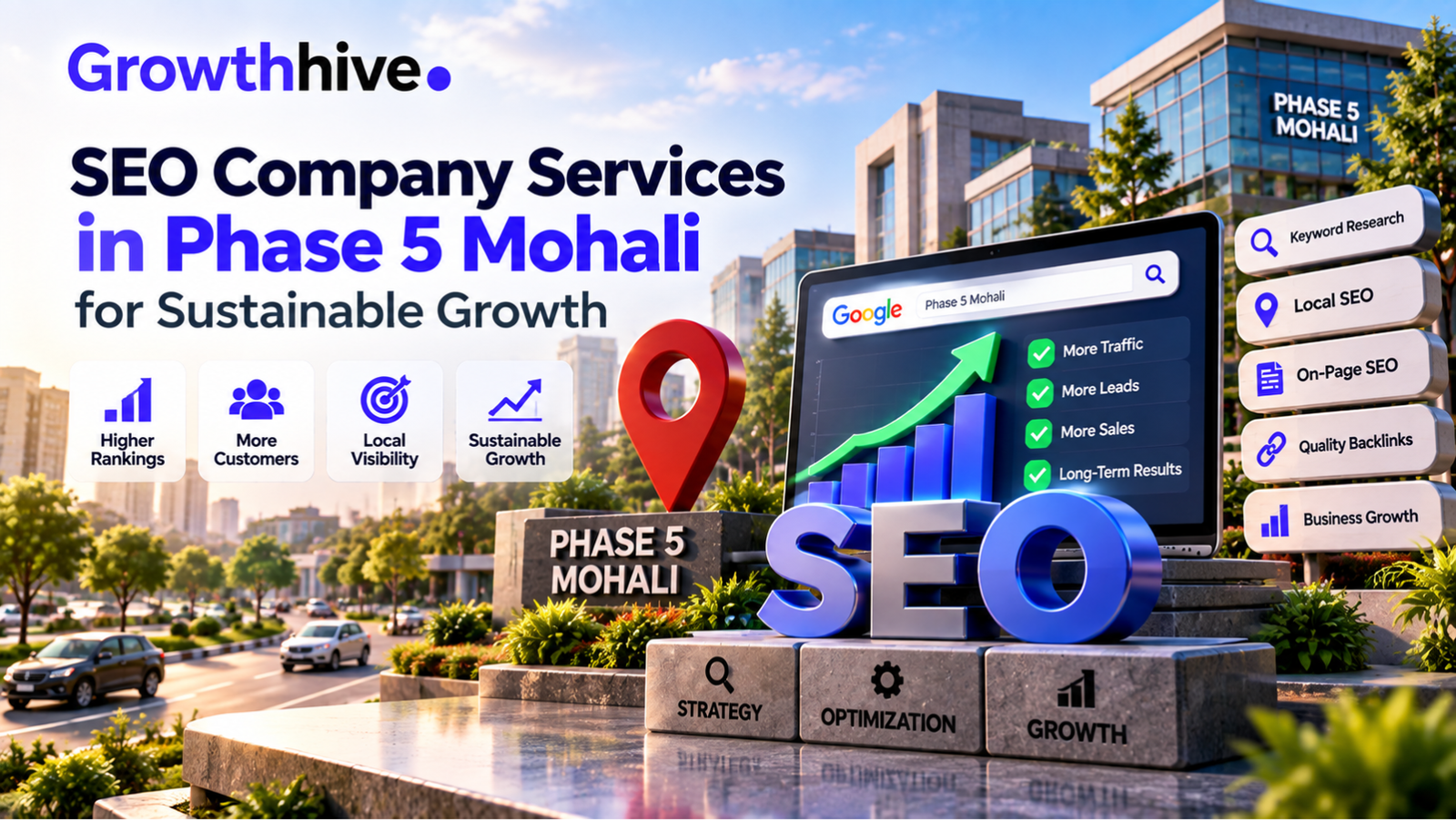
SEO Services GrowthHives Can Build Around Your Business
Different businesses require different SEO priorities. GrowthHives can structure an SEO program around the actual search opportunities and technical requirements of the website.
1. Technical SEO
Technical SEO establishes the foundation on which the rest of the strategy operates.
A technical SEO review may examine areas such as:
- Crawling
- Indexing
- Canonicalization
- Redirects
- XML sitemaps
- Robots.txt
- HTTP status codes
- Internal linking
- Duplicate or overlapping pages
- Structured data
- Mobile usability
- JavaScript-related search issues
- Core Web Vitals
- Site architecture
Not every website requires every technical change.
The objective is to identify issues that can affect search visibility, usability, or the ability of search engines to understand the website.
Google’s Search Central documentation provides guidance on technical requirements, Search Console, crawling, indexing, structured data, and other aspects of search visibility.
2. Keyword Research Based on Business Intent
Keyword research should answer a commercial question:
What does a potential customer search immediately before, during, and after deciding they need this service?
For a Phase 5 business, that can involve multiple layers.
Location-based searches
Examples may include:
- service + Phase 5 Mohali
- service + Mohali
- service + near me
- service + nearby areas
Service searches
These describe what the customer needs.
Examples:
- SEO services
- technical SEO
- local SEO
- ecommerce SEO
- SEO consultant
- SEO agency
Problem-based searches
These describe the customer’s underlying issue.
Examples:
- website not getting Google traffic
- website not generating leads
- low local visibility
- Google ranking dropped
- website traffic not converting
Commercial investigation searches
These indicate that the customer is evaluating providers.
Examples:
- SEO company in Mohali
- SEO agency Mohali
- SEO services pricing
- SEO consultant Mohali
A strong strategy connects these different search behaviors instead of building an isolated page for every slight keyword variation.
3. Local SEO for Mohali Businesses
Local SEO is particularly relevant when customers search for businesses based on location.
A local SEO strategy may include:
- Google Business Profile optimization
- Local landing-page strategy
- Service-area relevance
- Location-focused website content
- Consistent business information
- Review management processes
- Relevant local mentions
- Internal linking between service and location pages
- Local authority development
- Local conversion optimization
Google explains that Business Profile information contributes to how business information is presented across Google Search and Maps, and that information can come from the business, public web content, users, and other sources.
That means local SEO should not be treated as a separate activity disconnected from the website.
Your website, Business Profile, reviews, business information, and broader online presence should communicate a consistent picture of the business.
4. Service + Location Landing Pages
A common mistake is creating dozens of nearly identical city pages simply by replacing the location name.
That approach can create weak pages that provide little additional value.
A better approach is to create a location page only when there is a genuine search and business reason for it.
A useful Phase 5 landing page should provide information such as:
- Services available
- Business relevance to the area
- Problems addressed
- Areas served
- Local customer considerations
- Service process
- Relevant FAQs
- Conversion options
- Useful supporting resources
The page should answer a real local search need rather than exist only to capture a keyword.
5. On-Page SEO
On-page SEO makes it easier for users and search engines to understand what each page is about.
Depending on the page, optimization can include:
- Title tags
- H1 and heading structure
- Meta descriptions
- Page copy
- Search intent alignment
- Image alt text
- Internal links
- Entity relationships
- Content structure
- Relevant schema
- Conversion elements
The goal is not to repeat the target keyword as many times as possible.
Instead, the page should clearly communicate:
Topic → Problem → Solution → Evidence → Next Step
This produces a more useful experience for the person searching and creates a clearer topical relationship for search engines.
6. Content Strategy That Supports Revenue
Publishing content simply to increase the number of pages on a website rarely creates a strong SEO strategy.
Content should have a purpose.
A useful content system can include three layers.
Commercial Pages
These pages target people who are looking for a solution or service.
Examples:
- SEO services
- Local SEO
- Technical SEO
- Ecommerce SEO
- Industry-specific SEO
Supporting Educational Content
These pages answer questions potential customers have before making a decision.
Examples:
- How much does SEO cost?
- How long does SEO take?
- What does an SEO agency do?
- How to evaluate an SEO company
- Technical SEO checklist
Local and Business-Relevant Content
This content connects the service to the market.
For example:
- SEO for businesses in Mohali
- Local search trends
- Local SEO strategy
- Search visibility for service businesses
The objective is to create a connected topical ecosystem rather than a collection of unrelated blog posts.
7. AEO and AI Search Optimization
Search behavior is expanding beyond traditional blue-link results.
Businesses are increasingly interested in how their information may be surfaced across AI-powered search experiences.
GrowthHives can incorporate AEO and GEO-oriented principles into the broader content strategy.
This means making important information:
- Clear
- Direct
- Well structured
- Contextually complete
- Supported by credible information
- Easy to interpret
- Connected to relevant entities and topics
For example, instead of burying an important answer inside 800 words of introductory copy, an SEO page can provide a concise answer first and then explain the reasoning, process, exceptions, and examples.
This follows an answer-first structure that is useful for both people and search systems.
Google’s current Search documentation includes guidance around AI features and search appearance, while structured data can help Google understand certain types of page information.
However, no responsible SEO provider should guarantee inclusion in Google AI Overviews, AI Mode, ChatGPT, Gemini, Perplexity, or another AI system.
The practical objective is to create content that is genuinely useful, understandable, authoritative, and technically accessible.
8. Internal Linking That Builds Topical Authority
Internal links are often treated as a minor technical task.
They can instead be used as part of the website’s information architecture.
For example:
SEO Company Services
↓
Local SEO Services
↓
Local SEO Strategy
↓
Google Business Profile Optimization
↓
Local SEO FAQs
This structure helps users move from broad information toward increasingly specific solutions.
It can also help search engines discover relationships between pages.
Internal links should therefore be based on context.
A page should link to another page because the reader would reasonably benefit from it, not because the website needs another keyword-rich anchor.
9. SEO Should Be Connected to Lead Generation
Ranking for a keyword is not the same thing as generating business.
Consider two websites.
Website A
Receives organic traffic but has:
- Weak service pages
- No clear enquiry path
- Poor calls to action
- Generic content
- Confusing navigation
Website B
Receives qualified visitors and provides:
- Clear service information
- Strong relevance
- Useful supporting content
- Trust-building information
- Clear enquiry options
- Relevant calls to action
The second website has a stronger path from search → understanding → evaluation → enquiry.
That is the approach GrowthHives aims to build around SEO.
What Should You Measure From SEO?
A useful SEO reporting system should connect visibility with business outcomes.
Depending on the business, relevant metrics can include:
| SEO Area | Useful Measurements |
|---|---|
| Visibility | Search impressions, ranking visibility, search queries |
| Organic Traffic | Relevant organic sessions and landing-page traffic |
| Engagement | Engagement metrics and user behavior |
| Leads | Form submissions, calls, enquiries |
| Commercial Pages | Organic entrances and conversions |
| Local SEO | Local visibility, Business Profile interactions, calls |
| Technical SEO | Indexing, crawl and technical issues |
| Content | Traffic, impressions, engagement and conversions |
| Business Impact | Qualified enquiries and opportunities |
The exact KPI set should be customized to the business model.
A local service business should not necessarily use the same reporting framework as a national ecommerce store.
How GrowthHives Can Approach an SEO Campaign
A practical SEO engagement can be structured into several stages.
Stage 1: Discovery and SEO Audit
The first step is understanding the current website. This can include: Technical assessment Existing rankings Organic traffic Search Console data Existing content Competitor SERP patterns Local search presence Conversion paths Website architecture The purpose is to identify the actual constraints and opportunities.
Stage 2: Search and Opportunity Mapping
Next, search demand is mapped against: Services Locations Customer problems Commercial intent Supporting topics Existing pages Missing pages This helps determine which pages should be improved, consolidated, created, or internally linked.
Stage 3: On-Page and Technical Implementation
Priority pages are optimized based on the strategy. This can include technical corrections, content improvements, metadata, internal links, structured data where relevant, and conversion improvements.
Stage 4: Authority and Content Development
Once the core website is properly structured, the strategy can expand into supporting content and relevant authority-building activities. The objective is to strengthen important commercial pages rather than generate links or content without a strategic purpose.
Stage 5: Measurement and Refinement
SEO is iterative. Performance data can reveal: Which queries are gaining visibility Which pages need improvement Which topics deserve more coverage Where conversion opportunities exist Which technical issues remain Where search intent is changing The strategy should adapt accordingly.
Who Can Benefit From SEO Company Services in Phase 5 Mohali?
Professional SEO can be relevant to businesses such as:
Local Service Businesses
Businesses that depend on customers finding them in Mohali and surrounding areas can use local SEO to improve relevant search visibility.
Professional Services
Consultants, agencies, financial services, legal businesses, healthcare providers, and other professional firms can use SEO to build visibility around high-intent searches.
Ecommerce Businesses
Ecommerce websites can require a broader strategy covering categories, products, technical SEO, content, internal linking, and commercial search intent.
B2B Companies
B2B businesses can benefit from content that addresses complex customer questions throughout the research and evaluation process.
Startups
SEO can become part of a startup’s long-term acquisition strategy when the business has a clear market, offer, and search opportunity.
What to Look for When Choosing an SEO Company in Mohali
Before hiring an SEO provider, ask practical questions.
1. Will they explain the strategy?
You should understand what they intend to change and why.
2. Do they understand your business model?
SEO should connect to customers, services, margins, locations, and business objectives.
3. How will they measure success?
A serious conversation should go beyond rankings.
Ask how organic performance will be connected to qualified enquiries and business outcomes.
4. How do they handle technical SEO?
Technical problems can affect crawling, indexing, rendering, architecture, and the ability of search engines to understand a website.
5. How will content be developed?
Ask whether content will be created around actual customer questions and search intent or simply around keyword variations.
6. How will local SEO be handled?
For a local business, ask about Google Business Profile, location relevance, reviews, local landing pages, and local authority.
7. What happens when the data changes?
SEO requires ongoing analysis.
A strategy should have room for refinement rather than relying on a fixed list of tasks indefinitely.
Why SEO Should Not Be Treated as a One-Time Project
A website can be technically optimized today and still require future work.
Search behavior changes.
Competitors publish new pages.
Businesses add services.
Websites change.
Search engines evolve.
Customer expectations change.
AI-powered search experiences are also becoming part of the wider search ecosystem.
That makes SEO better suited to an ongoing improvement process.
The objective is to continuously identify opportunities and remove obstacles that prevent the website from attracting relevant organic demand.
A Practical SEO Framework for a Phase 5 Business
A useful way to think about the strategy is:
1. Understand the Business
What does the company sell, who buys it, and where?
↓
2. Understand Search Demand
What do potential customers search before contacting the business?
↓
3. Build the Right Pages
Which commercial and supporting pages should exist?
↓
4. Fix Technical Barriers
Can search engines efficiently crawl, understand, and index the website?
↓
5. Strengthen Local Relevance
Does the website and Business Profile clearly communicate the local connection?
↓
6. Build Useful Authority
Does the website demonstrate depth, relevance, and credibility?
↓
7. Improve Conversion Paths
Can a qualified visitor easily understand the offer and enquire?
↓
8. Measure and Refine
Which activities are creating meaningful visibility and business opportunities?
This approach keeps SEO connected to the business rather than treating it as an isolated marketing task.
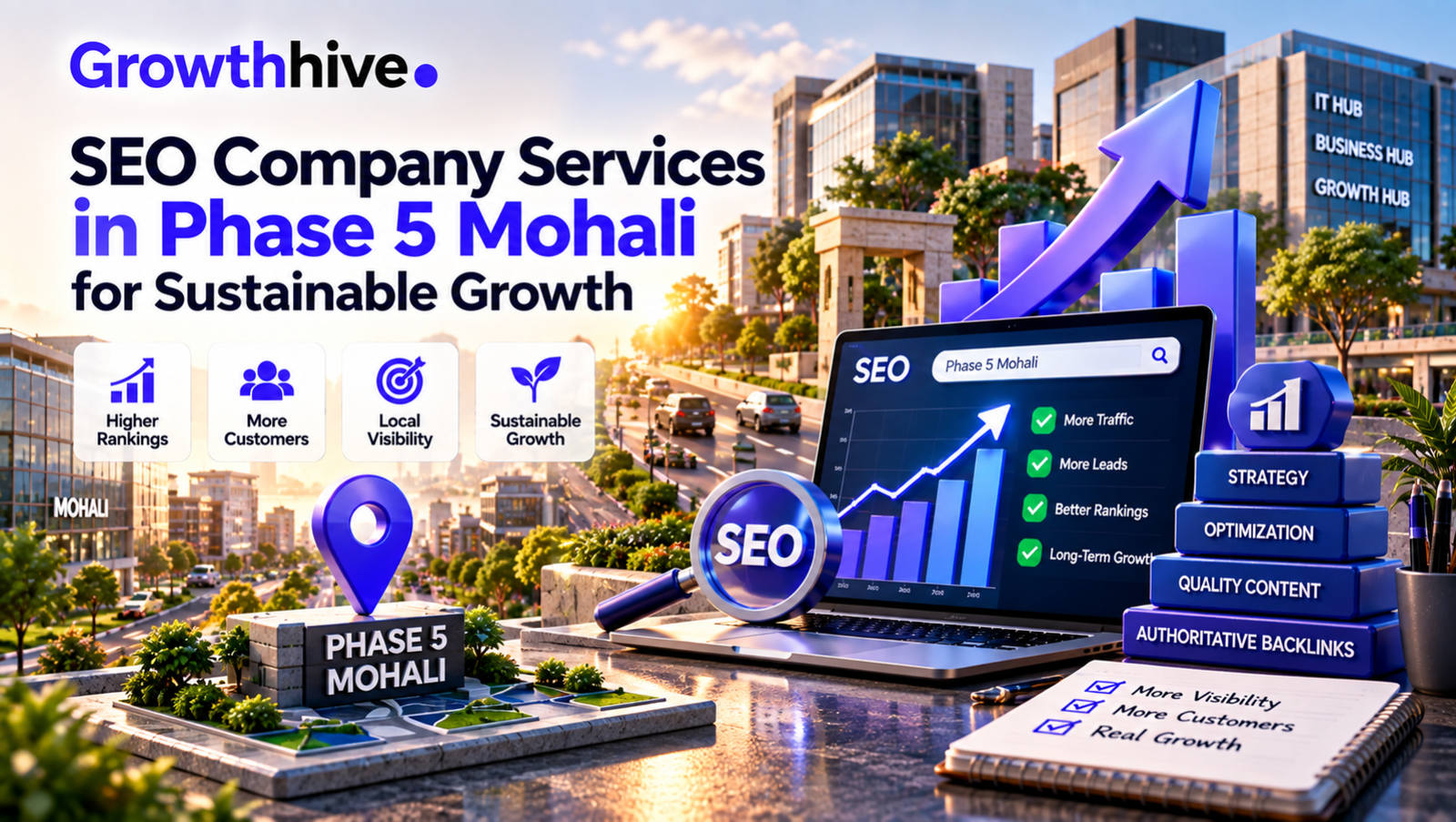
Why Growth Hives for SEO in Phase 5 Mohali?
Growth Hives approaches SEO around the full organic search journey.
Instead of focusing on one ranking factor, the strategy can connect:
- Technical SEO
- On-page SEO
- Local SEO
- Content strategy
- Keyword research
- Internal linking
- Organic growth
- AEO
- GEO
- AI-search considerations
- Conversion-focused SEO
The important distinction is not simply how many SEO activities are performed.
It is whether those activities support a coherent business objective.
For a Phase 5 Mohali business, that means understanding the local market while also building a website capable of competing beyond a single neighborhood when the business requires broader visibility.
You can explore GrowthHives’ broader SEO services to understand the wider service offering.
Start With the Business Problem, Not Just the Keyword
If your business is searching for SEO company services in Phase 5 Mohali, the most important question is not simply:
“How can I rank for this keyword?”
A more useful question is:
“How can organic search bring the right potential customers to my business and help them become enquiries?”
That shift changes the entire SEO strategy.
Instead of creating pages purely for rankings, the focus becomes:
Relevant search demand → useful content → stronger visibility → trust → qualified visitor → enquiry
If your website needs a more structured SEO strategy, GrowthHives can help assess the existing search opportunity and determine which areas should be prioritized first.
Discuss your SEO requirements with GrowthHives and build a strategy around your actual business goals.
Frequently Asked Questions
What does an SEO company in Phase 5 Mohali do? + -
An SEO company helps businesses improve their organic search visibility through activities such as technical SEO, keyword research, content optimization, local SEO, internal linking, authority development, and performance analysis.
The exact strategy should depend on the website, industry, competition, target market, and business objectives.
Is local SEO different from regular SEO? + -
Local SEO has a stronger geographic component.
It focuses on helping a business become relevant for searches connected to a specific location or service area. Google states that local results are primarily influenced by relevance, distance, and prominence.
Does an SEO company guarantee Google rankings? + -
A responsible SEO provider should not promise guaranteed rankings.
Search results depend on many factors outside an agency's direct control, and Google's systems are continually evolving.
A better approach is to define measurable objectives around visibility, relevant traffic, qualified enquiries, technical improvements, and other business-specific KPIs.
How long does SEO take? + -
There is no universal SEO timeline.
The timeframe can depend on factors including:
- Website history
- Technical condition
- Existing authority
- Competition
- Search demand
- Content quality
- Target market
- Number of pages
- Resources available for implementation
A proper assessment should come before giving a specific timeline.
But Growth Hives takes only 3 months to rank on top page of google, gpt's llm's and everywhere.
Can SEO help a business outside Phase 5? + -
Yes.
A business can use local SEO for Phase 5 and surrounding areas while also building broader city, regional, national, or international visibility where appropriate.
The architecture should reflect the actual market the business wants to serve.
Can SEO help with AI search visibility? + -
SEO, structured content, clear answers, strong topical relevance, technical accessibility, and credible information can all contribute to making a website easier for modern search systems to understand.
However, visibility in AI-generated search features cannot responsibly be guaranteed.
Google's current documentation recognizes AI features as part of the search landscape and provides guidance around search appearance and related features.
What should I ask before hiring an SEO company? + -
Ask about:
- Their SEO process
- Technical SEO methodology
- Keyword research
- Content strategy
- Local SEO approach
- Reporting
- KPIs
- Communication
- Implementation responsibilities
- How they handle changes in strategy
Most importantly, ask how their work will connect to your actual business objectives.