
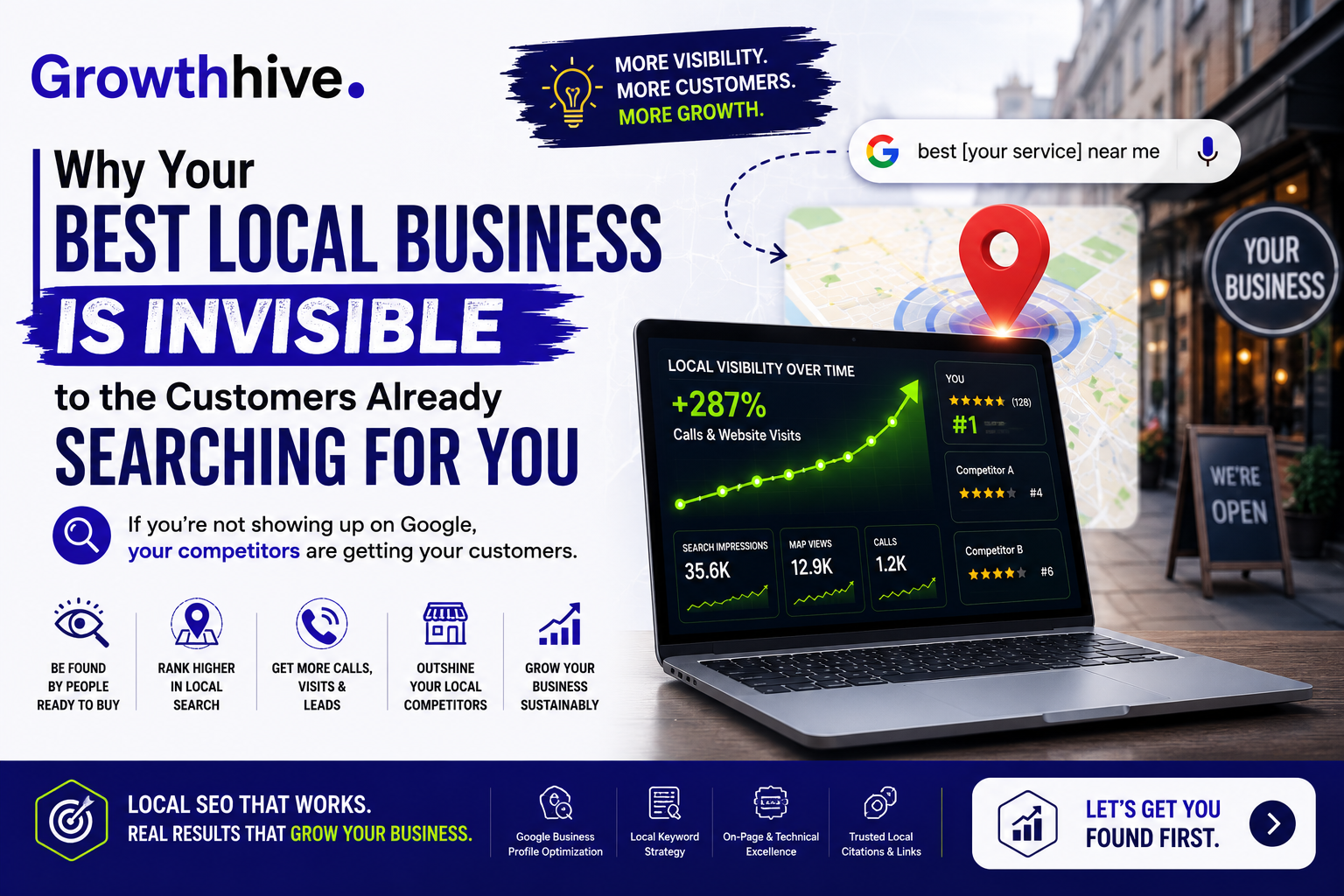
Your storefront could be the best-reviewed shop on the street — and still lose every single customer who typed “near me” into Google before walking anywhere. That’s the uncomfortable truth most local founders discover too late: visibility, not quality, decides who gets picked first. This is exactly why a solid organic search strategy for local businesses isn’t optional anymore — it’s the difference between being the obvious choice and being invisible on page two.
If you’re a founder, clinic owner, home-service provider, or multi-location retailer wondering why competitors with worse products keep outranking you, this guide breaks down exactly how an effective organic search strategy for local businesses works — the mechanics, the framework, the myths, and how to evaluate whether an agency can actually deliver it.
What Is an Organic Search Strategy for Local Businesses?
An organic search strategy for local businesses is a structured, non-paid approach to ranking a business’s website and Google Business Profile for the searches its ideal local customers are already typing — things like “[service] near me,” “[service] in [city],” and comparison-style queries. Unlike paid ads, which stop the moment budget runs out, this strategy compounds: rankings built through technical optimization, content, and local authority signals keep generating visits, calls, and bookings month after month without a per-click cost.
The core difference from generic SEO is proximity and intent — local strategy blends Google Business Profile optimization, location-specific landing pages, review velocity, and locally-relevant backlinks with standard technical and content SEO, all mapped to how nearby customers actually search and decide.
Why Paid Ads Alone Can’t Replace an Organic Search Strategy for Local Businesses
Paid ads get you a spot at the top instantly — but the moment you pause spend, that visibility disappears completely. Meanwhile, ad costs for competitive local categories (home services, legal, healthcare, real estate) have climbed steadily year over year, squeezing margins on every lead.
An organic search strategy for local businesses works differently. It’s slower to build — most founders see first movement in Google Search Console within 3–5 weeks, with compounding gains typically visible by day 90 — but once rankings stabilize, the traffic keeps arriving without an ongoing per-lead cost. Smart founders don’t choose one over the other; they use paid ads for immediate pipeline while organic compounds in the background, eventually taking over as the dominant, lower-cost-per-lead channel.
The 6-Phase Framework Behind a Winning Organic Search Strategy for Local Businesses
Most agencies sell “SEO” as a vague monthly retainer with no visible system. At Growth Hive, every organic search strategy for local businesses we build runs through the same proprietary Advanced SEO Framework™:
- Deep Technical Audit — Core Web Vitals, crawlability, indexation issues, mobile performance, and local schema gaps are mapped before anything else is touched.
- Keyword & Intent Mapping — city, neighborhood, and service-level keywords are mapped to search intent (informational vs. transactional vs. local-navigational), avoiding cannibalization across location pages.
- Content Engineering — location landing pages, service pages, and supporting blog content are built to satisfy both searcher intent and E-E-A-T signals, AI-drafted from keyword/SERP-gap research and then fully human-edited.
- Authority Link Building — white-hat, topically relevant backlinks and local citations build the trust signals Google uses to rank nearby businesses above generic national sites.
- Tracking & Reporting — a real-time ranking and traffic dashboard replaces the vague monthly PDF, with weekly reporting on movement.
- Conversion Optimization — because ranking without converting is wasted traffic; call tracking, form optimization, and Google Business Profile CTAs are tuned continuously.
This 6-phase structure is what separates a genuine organic search strategy for local businesses from scattered, one-off tactics like “just post more on Google Business Profile.”
DIY vs. Freelancer vs. In-House vs. Agency: Comparison Table
| Approach | Typical Monthly Cost | Speed to Results | Technical Depth | Best For |
|---|---|---|---|---|
| DIY (Owner-led) | Time only | Slow (6+ months) | Low | Very early-stage, single-location businesses |
| Freelancer | Low–moderate | Moderate | Variable, single-skill | Businesses needing one narrow fix (e.g., GBP only) |
| In-House Hire | High (salary + tools) | Moderate–fast | High, but limited to 1 person’s bandwidth | Larger, multi-location brands with budget for a full team |
| Specialized Agency | Moderate, scalable | Fast (first movement in weeks) | High, full senior squad | Founders who want a done-for-you, accountable system |
An agency-led organic search strategy for local businesses typically wins on speed and accountability because it replaces the need to hire a full in-house team — a strategist, content engineer, technical SEO specialist, and link builder — for a fraction of the cost of four salaries.
https://docs.google.com/document/d/19_1mZDNJKw3u21uRi5M29AjwqoxGMCS7GOSiN0yn30g/edit?usp=sharing
Myths & Misconceptions About Local SEO
Myth 1: “Google Business Profile alone is enough.”
GBP optimization matters, but it’s one signal among many. Without a supporting website, location pages, and backlinks, GBP rankings plateau fast because Google can’t verify authority beyond the profile itself.
Myth 2: “SEO results are instant.”
This misconception exists because paid ads deliver instant visibility, and people expect organic to behave the same way. In reality, Google needs time to crawl, index, and trust new signals — which is why a realistic organic search strategy for local businesses is measured in weeks and months, not days.
Myth 3: “More keywords stuffed on a page = better rankings.”
This was true a decade ago under older algorithms. Today, keyword stuffing actively hurts rankings and readability; modern algorithms and AI Overview extraction favor clean, direct, well-structured answers over density tricks.
How to Evaluate an Agency for Your Organic Search Strategy for Local Businesses (Checklist)
Before signing with anyone, confirm they offer:
- A written guarantee — Page 1 / Top 10 on agreed keywords within 30–90 days, or a full refund
- No long-term lock-in — month-to-month terms, cancel with 14 days’ notice, and you keep all delivered work
- A real-time dashboard — not a static monthly PDF you have to chase
- A named strategist reachable directly, not a rotating support inbox
- Transparent process — can they explain their framework in plain language, phase by phase?
- White-hat link building only — ask directly how they source backlinks
Case Study: A Multi-Location Service Business Turnaround
A regional home-services business operating across three cities came in with strong reviews but almost zero organic visibility outside its original location. The Deep Technical Audit (Phase 1) revealed duplicate, thin location pages competing against each other for the same terms — classic cannibalization. Keyword & Intent Mapping (Phase 2) rebuilt each location page around distinct, non-overlapping service-area terms, and Content Engineering (Phase 3) added locally-specific FAQ and case-study content to each. Within the first 90 days, Search Console showed steady impression growth across all three markets, with the newest location page reaching page-one visibility for its core service term by week 11 — without any additional ad spend.
Frequently Asked Questions
How long does an organic search strategy for local businesses take to show results?
Most businesses see initial Search Console movement — new impressions and keyword indexing — within 3–5 weeks. Meaningful ranking gains and lead flow typically compound by day 90, depending on competition level and starting site health.
Is local SEO different from regular SEO?
Yes. A local strategy layers proximity signals — Google Business Profile, location pages, local citations, and nearby backlinks — on top of standard technical and content SEO, since local search intent prioritizes distance and trust alongside relevance.
Can I run paid ads and organic SEO at the same time?
Absolutely, and most founders should. Paid ads deliver immediate leads while an organic search strategy for local businesses builds in the background, eventually lowering overall cost-per-lead as rankings mature.
What’s the biggest mistake local businesses make with SEO?
Treating Google Business Profile as the entire strategy. Without supporting website content, technical health, and backlinks, GBP visibility alone rarely sustains long-term growth.
Do I need a website for every city I serve?
Generally yes — one well-optimized location page per service area, built to avoid keyword overlap, performs far better than a single generic page trying to rank everywhere at once.
How much should I budget monthly for this?
Costs vary by competition and scope, but a scalable agency retainer is typically far below the combined cost of hiring an in-house strategist, content writer, technical specialist, and link builder separately.
Key Takeaways
- An organic search strategy for local businesses compounds over time, unlike paid ads that stop the moment spend does
- Results typically show first movement in 3–5 weeks, with compounding gains by day 90
- A real framework — not scattered tactics — is what separates results from wasted budget
- GBP alone is not a complete strategy; it needs technical, content, and link support
- Always evaluate agencies against a written guarantee, transparent dashboard, and no long-term lock-in
- Combining paid + organic gives the fastest path to sustainable, lower-cost-per-lead growth
Conclusion
Your local customers are already searching — the only question is whether they find you or your competitor first. A properly executed organic search strategy for local businesses turns that search behavior into a predictable, compounding source of calls, bookings, and revenue, without the constant spend of paid ads. Growth Hive builds this exact system for 200+ founders through the 6-phase Advanced SEO Framework™, backed by a written Page 1 guarantee and zero long-term contracts.
👉 Book Your Free Call and see exactly where your current local visibility stands.